
Last Updated: March 22, 2026
Contents of This Post:
- The Legal Landscape of Pregnancy Termination in India: Your Right to Choose: Firstly, Answering Is Abortion in India Legal?
- Prioritizing Your Health: Safely Navigating Abortion Care: Secondly, Answering Is Abortion Safe?
- Then, let us help you in Understanding Your Options: The Methods of Abortion
- Demystifying the Abortion Costs: Financial Clarity for Your Decision: Next, answering what is the cost of abortion
- Finally, Finding Your Way Forward: Support and Aftercare
Welcome. If you’re reading this, you might be navigating a deeply personal and potentially difficult moment in your life. We want you to know, right from the start, that you are not alone, and your feelings are completely valid. Deciding to terminate a pregnancy is a complex choice, one often faced with a whirlwind of emotions, questions, and concerns.
This blog post is for you – to provide clear, accurate, and, most importantly, empathetic information about accessing a safe, legal and confidential abortion in Bangalore. We understand the stigma that often surrounds this topic, and our goal is to cut through the noise with facts and kindness. We want to empower you to make the decision that is best for you, armed with knowledge and supported by the understanding that your well-being is the absolute priority.
Let’s explore this together, step by step.
The Legal Landscape: Your Right to Choose
India’s legal framework around abortion is, and should be, a source of significant reassurance for anyone seeking this care. It is vital to understand that abortion is not only legal but has recognition as a crucial aspect of healthcare, deeply connected to a woman’s bodily autonomy.
The cornerstone of this is the Medical Termination of Pregnancy (MTP) Act, first passed in 1971. A momentous step in 2021 came with the Medical Termination of Pregnancy (Amendment) Act, which significantly expanded reproductive rights.
What does the abortion in India rules mean for you today?
- Firstly, Universal Access: The 2021 amendment is a beacon of progress. It removed the word “married” and replaced it with “any woman or her partner,” making legal and safe abortion services accessible to all women, regardless of their marital status. This is a crucial step in ensuring that single women can access healthcare without fear or judgment.
- Secondly, Expanded Timeframe: The legal limit for terminating a pregnancy increased with this amendment. Now, pregnancy termination for up to 20 weeks require the opinion of only one registered medical practitioner.
- Next, Exceptions for Vulnerable Situations: Now, for specific categories of women – including survivors of sexual assault, rape, or incest, and minors – the Act allows for termination up to 24 weeks. This decision requires the opinion of two registered medical practitioners.
- Additionally, no ceiling for fetal anomalies: If there is a substantial fetal anomaly, there is no upper gestation limit for termination, provided there is approval by a state-level Medical Board for later-term pregnancy termination.
This legal framework prioritizes your safety and health. Besides, it establishes that a decision to terminate a pregnancy is a medical decision. So, you and your doctor can decide this free from arbitrary barriers.
Prioritizing Your Health: Safely Navigating Abortion Care
Your health and safety are the most critical factors in this entire journey. So, understanding what constitutes safe care is essential to protecting yourself from harm.
Firstly, let’s understand what is a safe abortion?
A safe abortion is one, performed by a qualified healthcare professional (like a gynaecologist) using methods recommended by the World Health Organization (WHO), appropriate for the pregnancy’s gestation, and in an environment that meets medical standards.
Now, let’s Explore the Dangers of Unsafe Methods
The stark and painful truth is that unsafe abortions are a major cause of maternal mortality and morbidity worldwide. These are abortions performed by individuals who lack the necessary skills, or in an environment that does not conform to minimal medical standards, or both.
Seeking an abortion through unauthorized channels, using unproven home remedies, like papaya or pineapple to induce a miscarriage or obtaining pills from unlicensed sources can lead to severe and life-threatening complications, including:
- Incomplete abortion: When some of the pregnancy tissue remains in the uterus, which can lead to heavy bleeding and infection.
- Haemorrhage: Severe bleeding that requires immediate medical attention.
- Furthermore, Infection: Sepsis is a serious potential outcome of unsafe procedures.
- Uterine perforation: Damage to the wall of the uterus.
- Also, Long-term complications: This can include chronic pelvic pain as with pelvic inflammatory disease, and future infertility.
Now, How to Ensure Your Safety with an Abortion in Bangalore?
- Firstly, Choose a Registered Medical Practitioner: Your first step should always be to consult with a registered gynaecologist. Registered medical practitioners at registered MTP centres can assess your health, confirm the pregnancy’s gestation, and recommend the safest abortion method for you.
- Secondly, Seek Care at an Approved Facility: The MTP Act mandates that registered medical practitioners can can perform pregnancy terminations only at hospitals or clinics approved by the government for this purpose. So, look for institutions that are transparent about their status and qualifications.
- Next, Be Wary of Confidentiality Promises: While confidentiality is essential (and a legal right), be cautious of places that use extreme secrecy as a way to hide a lack of proper licensing or qualified staff. Remember, a legitimate medical facility will uphold your privacy within a professional, ethical framework.
- Finally, Trust Your Instincts: If a situation, place, or person feels unsafe or unprofessional, trust your gut. You have the right to seek care from someone who makes you feel respected and safe.
Understanding Your Options: The Methods of Abortion
The method used for your abortion will depend primarily on how far along your pregnancy is after ruling out the risk of ectopic pregnancy. Your doctor will discuss the options with you after a physical examination and an ultrasound to confirm the gestation period. There are two main approaches:
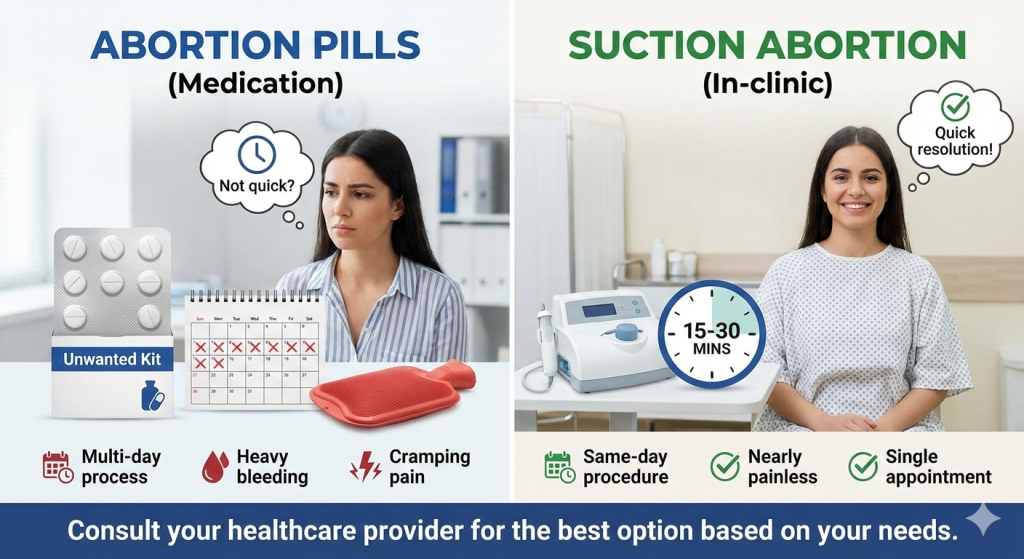
Medical Abortion (Abortion with Pills):
When is it appropriate? Generally, medical abortion is highly effective and safe for pregnancies up to 6 weeks of gestation. However, this is not the most efficient abortion method as it can still result in an incomplete abortion even after medical supervision and extreme caution.
How does it work? It involves taking two different medications.
- Mifepristone: This is the first pill you’ll take, often in the clinic. It blocks the hormone progesterone, which is essential to maintain a pregnancy.
- Misoprostol: The second medication is taken 24 to 48 hours later, usually at home. It causes the uterus to contract and empty, leading to cramping and bleeding, similar to a heavy period or a miscarriage.
What to expect?: You should expect cramping and bleeding that will be heavier than a regular period. The process can take several hours to a few days. Common side effects can include nausea, vomiting, diarrhoea, and a low-grade fever. Your doctor will provide you with pain management guidance and instructions on when to seek medical attention. Also, a follow-up visit is crucial to confirm the abortion is complete.
Surgical Abortion (In-Clinic Procedures)
When is it appropriate? Surgical methods are available for pregnancies up to 20 weeks. However, the approach depends on the exact length of the pregnancy at the time of termination.
Common procedures:
- Firstly, Vacuum Aspiration or Suction Abortion: This is the most common method for in-clinic abortion (up to 12-14 weeks). It involves using gentle suction to empty the uterus. Also, the procedure is quick (about 5-10 minutes) and usually performed under local or light general anaesthesia.
- Secondly, Dilation and Evacuation (D&E): This method is for pregnancies after 12 weeks. It involves dilating the cervix and using a combination of suction and medical instruments to remove the pregnancy tissue under general anaesthesia. At Bangalore Genesis Hospital, we use labor induction followed by D&E to ensure that pregnancy termination is complete before the patient leaves the hospital.
What to expect? Trained abortion doctors perform surgical procedures in a clinic or hospital setting. You may experience mild cramping during and after the procedure. Bleeding will follow, but it is typically less and lasts for a shorter time than with a medical abortion. Besides, the best advantage of a surgical abortion is that it completes in a single visit, and you will know it is complete before you leave the facility.

Demystifying the Abortion Costs: Financial Clarity for Your Decision
One of the most significant worries when seeking any medical care is the cost. It’s important to have a realistic understanding of the potential expenses so you can plan accordingly. The cost of an abortion in Bangalore can vary widely based on several factors.
Factors Influencing Cost of Abortion:
- Method of Abortion: Medical abortion (the pills) is generally less expensive than a surgical procedure. But can turn out to be costly with incomplete abortion requiring additional procedure to complete the abortion.
- Weeks of Gestation: Generally, the earlier the abortion, the less expensive the procedure will be. Later-term abortions are more complex and require more resources.
- Type of Healthcare Facility: Costs can differ significantly between private clinics, corporate hospitals, and government hospitals. Private facilities are more expensive but often offer more convenience and shorter wait times.
- Doctor’s Fees: The experience and reputation of the gynecologist can influence the cost.
- Additional Tests: Pre-abortion tests like blood work and ultrasound will add to the final bill.
- Medications and Anaesthesia: For surgical procedures, the cost of anaesthesia and post-operative medications will be factored in.
- Aftercare and Follow-up Visits: While sometimes included in a package, follow-up appointments and any necessary post-procedure medication are worth considering.
Rough Abortion Cost Estimates in Bangalore (as of 2026):
- Medical Abortion (with consultation and ultrasound): Range can be from INR 6,000 to INR 10,000, depending on the private clinic.
- Surgical Abortion (Vacuum Aspiration, early stage): Range can be from INR 15,000 to INR 30,000 in a private clinic. In corporate hospitals, this can go up to INR 50,000 or more.
- Surgical Abortion (D&E, later stage): Range can be from INR 25,000 to INR 60,000 or more in private settings.
Crucial Note on Government Options:
The law requires the government hospitals in Bangalore to provide MTP services for free or at a very minimal, nominal cost. While wait times can be longer and the environment less private than a private clinic, this is a vital and cost-effective option for many.
Financial Transparency is Your Right:
Always ask for a clear, written estimate of the total costs before you proceed with any treatment. A reputable facility will have no problem providing this information.
Finding Your Way Forward: Support and Aftercare
The journey doesn’t end with the procedure itself. Your body and mind need time and space to heal.
Physical Aftercare:
- Rest: Give your body the rest it needs. Avoid strenuous activity for a few days.
- Bleeding and Cramping: Expect some bleeding and cramping. Use sanitary pads, not tampons, to reduce the risk of infection. Your doctor will advise on pain relief options.
- Infection Prevention: Avoid sexual intercourse and swimming for at least a week or two, or, as advised by your doctor.
- Follow-up: This is absolutely non-negotiable. Whether it’s to confirm a medical abortion is complete or for a post-surgical check-up, that follow-up visit is essential for your health.
Emotional Support:
The emotional aftermath of an abortion can be a spectrum. You might feel relief, sadness, guilt, or a mix of everything. All these feelings are valid.
- Seek Out Trusted Confidants: Talking to a supportive friend, partner, or family member can be incredibly healing.
- Professional Counselling: A therapist or counsellor can provide a safe, non-judgmental space to process your feelings and develop coping strategies.
- Support Groups: Connecting with others who have had similar experiences can feel deeply validating and less isolating.
- Online Resources: Many organizations offer resources, forums, and hotlines for post-abortion support. Ensure these are from reputable, non-judgmental sources.
A Final Word
Your decision is your own, and it is a valid one. This guide is meant to be a resource of accurate information, framed with the understanding and compassion you deserve. You are taking a step that prioritizes your future and well-being. By choosing safe, legal care and seeking the support you need, you are navigating this journey with strength and responsibility.
Please, reach out to a registered gynaecologist or a trusted healthcare provider in Bangalore to start this conversation. Your health, both physical and emotional, is the most important thing. You are not alone on this path.
Schedule a confidential consultation today.
Related Posts:
- Motherhood Is a Choice: Respecting Every Woman’s Right to Choose
- How Much Rest is Necessary After an Abortion?
- If You Want a Same-Day Abortion, Unwanted Kit is Not For You
- How Soon Can You Resume Your Routine After an Abortion?
- Abortion for Unmarried Without Parental Consent: What You Need to Know?
Quick Links:
- 6 Condom Myths That Lead to Surprise Pregnancies
- The ₹1.06 Lakh Protection: What Happens When Plan Goes Wrong
- Understanding What Your Menstrual Cycle Speaks & When it Seeks Attention
- Reproductive Rights Shape Futures: Why Every Woman’s Choice Matters?
- When do Abortion Pills Start Working? Abortion Doctor Answers
