
Contents of This Post:
- Reproductive Rights: The Foundation of Women’s Health and Autonomy
- How Strong Laws Shape Women’s Lives—and Society’s Future?
- Scenario Where Rights Are Restricted: The Real-World Consequences for Women and Communities
- India’s Evolving Stand on Reproductive Rights
- What India Gets Right: Lessons for the Rest of the World?
- How Individuals and Communities Can Strengthen Reproductive Rights?
- Understanding Abortion Rights in India Today
- Safe, Legal, and Compassionate Abortion Options in Bangalore
When communities protect reproductive rights, women and families thrive. When communities deny those rights, people pay a steep price — for health, for opportunity, and for dignity. This post explains why carefully framed reproductive rights matter, how India moves forward, where we still need progress, and how individuals can help. Then, we will also have a look at abortion in India choices and why Bangalore stands out for safe, legal, confidential care that follows global best practices.
Reproductive Rights: The Foundation of Women’s Health and Autonomy
Reproductive rights put control back where it belongs: with the person who will live the consequences. Those rights cover access to contraception, safe abortion, maternity care, fertility services, and the information and counselling people need to choose freely. When legal frameworks protect those rights, women decide when and if to have children, finish school, build careers, and plan stable families — all of which shape social and economic futures.
People who enjoy reproductive autonomy make healthier choices. They seek preventive care earlier, complete recommended screenings, get proper vaccinations like HPV and maintain steady contact with providers. Those small acts compound into large public-health gains: fewer unwanted pregnancies, safer births, and lower rates of maternal illness and death.
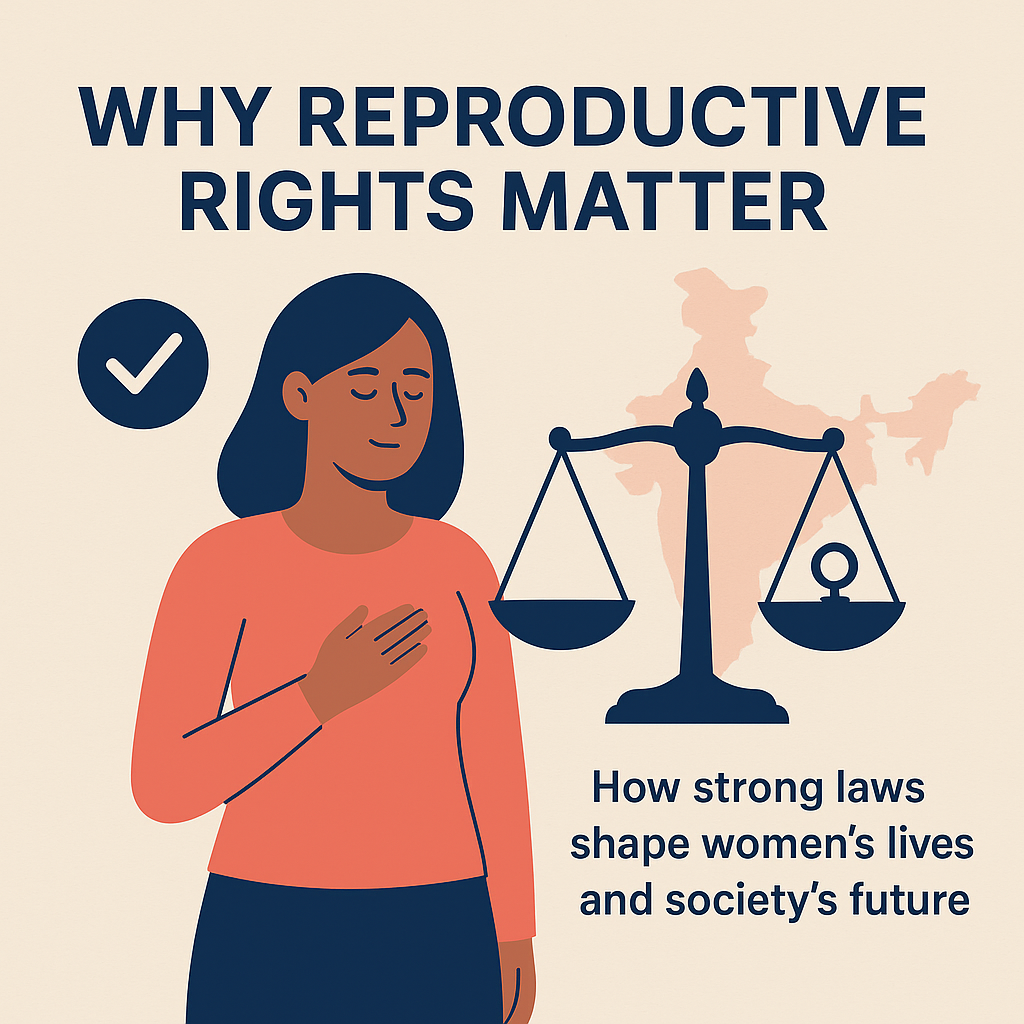
How Strong Laws Shape Women’s Lives — and Society’s Future?
Strong reproductive laws don’t just exist on paper — they shape how women live, dream, and move through the world. When lawmakers recognise women’s autonomy and create clear legal pathways to access contraception, safe abortion, and maternal healthcare, they set the stage for healthier communities and more resilient families.
Well-designed laws remove confusion and replace fear with clarity. They tell women, “You have the right to make decisions about your own body, and the system will support you.” That assurance builds confidence. Women use healthcare services earlier, ask questions freely, and choose care that aligns with their needs, rather than what stigma or pressure dictates.
Strong laws also strengthen healthcare systems. When governments craft rights-based policies, clinics train their staff better, expand services confidently, and invest in safety, counselling, and follow-up care. A clear legal framework encourages providers to work without fear of litigation or moral accusations, thereby improving service quality and reducing harmful delays. Nurses, counsellors, and doctors feel empowered to provide unbiased, compassionate care because the law stands with them.
The impact doesn’t stop with individuals.
When more women control their reproductive lives, communities experience measurable gains:
- Firstly, families plan pregnancies responsibly, improving children’s health and long-term outcomes.
- Secondly, women pursue higher education and secure better jobs because unplanned pregnancies no longer derail their dreams. Besides, if having children is not their choice, like in the case of DINK couples or may become an obstacle in their career aspirations or profession’s demands, they can choose what feels best for them. And when they choose freely, they will be physically, emotionally, and mentally inclined to contribute more to the cause. Conscious choices make better executors than ones that one may have to carry as a burden.
- Then, households rise out of poverty as women participate more fully in the workforce. Just as mentioned above, women in such cases will be progressive and productive with a complete involvement in whatever they choose.
- Maternal deaths and complications decline dramatically, easing pressure on public health systems. When women know their reproductive rights, they can confidently walk into the clinics and ask for the care they deserve.
When societies protect reproductive choices, they unlock potential that often goes unnoticed: women start small businesses, lead research labs, and shape public policy. That ripple transforms entire economies.
The opposite is also true.
Weak, unclear, or restrictive laws sow confusion. Women hesitate to seek care, fear judgment, or rely on unsafe alternatives. Healthcare providers become uncertain about what they can legally offer, which leads to unnecessary refusals, harmful delays, or unsafe medical practices. These consequences harm not just individuals but society as a whole — through higher healthcare costs, reduced productivity, and preventable human suffering.
When a choice is enforced, it is likely to become a burden in the long run. Even if someone does not realise it at that moment, when they see their lives 10 or 20 years back, they may carry an emotional trauma. And they may live in a “what if” scenario. Not only this, they may pass on their trauma to future generations of the household, holding back the reproductive choices of new generation couples.
On the other hand, strong laws make a difference because they signal a nation’s values. They tell the world whether we treat women as full citizens with rights and agency or as people who need permission to make decisions about their own futures. When reproductive rights sit at the centre of policy, nations thrive. However, wWhen they stand on the side lines, progress stalls.
When Rights Are Restricted: The Real-World Consequences
Restricted reproductive rights don’t just limit healthcare access — they reshape entire lives. When the law denies women the freedom to make decisions about their own bodies, it forces them into situations that affect their health, emotional well-being, economic stability, and their families’ futures. These consequences reach far beyond the individual woman; they ripple through households, communities, and generations.
When rights are unclear or restrictive, fear often replaces confidence. Women hesitate before seeking help, even when they recognise the warning signs of a medical problem. Many avoid hospitals because they fear stigma, judgment, or legal consequences. Others continue unsafe pregnancies or pursue unsafe abortions simply because safe care remains out of reach. Their choices are not a reflection of irresponsibility — they are a response to the barriers placed in front of them.
In such environments, unsafe abortion becomes a predictable outcome. Women try herbal concoctions or methods like papaya for abortion or pineapple for abortion, seek untrained providers, or buy unregulated medication. These actions come from desperation, not carelessness. Yet the consequences can be devastating: severe infections, toxic reactions, infertility, chronic pain, psychological trauma, and in many cases, preventable deaths.
Let’s imagine what restricted rights look like in real life.
A young unmarried woman discovers an unplanned pregnancy in a country where abortion is illegal or heavily policed, like in Dubai, Abu Dhabi, Maldives, Mauritius, Qatar, the Philippines, Kuwait, Singapore, Indonesia, Oman, Sri Lanka and the list continues. She fears her family’s reaction and knows the law won’t protect her. She hides her situation, searches online, buys unsafe pills, or visits someone with no medical training. Her decision places her health and life at immediate risk — all because she felt she had no other option.
Now consider a married woman with two children, struggling financially. She knows another pregnancy will push her family deeper into poverty, and yet her country’s laws deny her the choice to terminate. Her future shrinks. Her ability to work, pursue education, or care for her existing children suffers because she cannot decide what happens to her own body.
When reproductive rights shrink, gender inequality grows.
Women lose the ability to plan their education, careers, relationships, and long-term aspirations. Society begins to treat motherhood as an obligation rather than a choice. As a result, girls drop out of school. Women leave jobs or never enter the workforce at all. Poverty cycles intensify within families. Healthcare systems strain under complications from unsafe abortions and high-risk pregnancies that could have been avoided.
Restricted rights also create social silence. Women stop talking about their experiences because they fear judgment or punishment. This silence protects no one; it only increases misinformation, stigma, and unsafe decision-making. When society sacrifices open dialogue, it also sacrifices women’s safety.
India offers a unique perspective here. Although abortion is legal under the MTP Act, many women still hide pregnancies due to stigma or lack of awareness. Some self-medicate with abortion pills purchased without guidance. Others delay care until complications arise. This reflects a global truth: laws alone cannot change outcomes unless society supports women through awareness, compassion, and dignified healthcare.
Ultimately, when reproductive rights shrink, society pays a heavy price.
- Healthcare costs rise as complications increase.
- Families struggle emotionally and financially.
- Children grow up in unstable environments that directly impact what they become and how they contribute to society, which can be positive in 1 out of 10 cases, but 9 are usually negative.
- Economies lose the contribution of millions of women who could have thrived.
Restricting reproductive rights doesn’t prevent abortions or unplanned pregnancies — it only prevents safe ones. And every time a woman risks her life because her rights stand out of reach, society loses far more than one life; it loses potential, creativity, and the stability that empowered women bring to their communities.
Why Restricting Abortion Rights Hurts Women—and Society
Abortion stands as an important reproductive choice for every woman, yet not every country gives women the legal power to access it safely. When the law blocks or complicates that choice, women and couples often feel cornered. In desperation, many turn to unsafe and unregulated methods. These choices risk far more than their immediate health — they jeopardise their future, their families’ stability, and the overall well-being of society.
Take a simple example many communities witness every day: a couple quietly buying abortion pills like Unwanted Kit or any other MTP kit without a prescription. Pharmacies that allow this exchange usually charge more than the MRP, turning a medical need into a backdoor transaction. This practice promotes corruption, enables unethical distribution of abortion pills, and fuels a dangerous shadow market.
But the larger danger lies with the woman who consumes these pills without proper medical guidance. She steps into the unknown without knowing whether she carries an ectopic pregnancy, whether her gestational age allows for medical abortion, or whether her body can safely process the medications. This leads to outcomes that could have been avoided — heavy bleeding, incomplete abortion, severe pain, infection, ectopic pregnancy rupture, or other medical emergencies.
Unsafe abortions remain one of the leading causes of maternal mortality and morbidity worldwide.
They rank among the top three causes of maternal deaths in India and stand as a major concern across Southeast Asia. These are not just numbers; they represent women whose lives could have taken a different direction if they had access to accurate information, safe services, and supportive laws.
The consequences of a botched abortion can follow a woman for life. Chronic conditions such as Pelvic Inflammatory Disease (PID), infertility, long-term pain, recurrent infections, and even life-threatening complications can arise. And when fear pushes a woman to seek help from an unqualified provider or a quack, the risks multiply — internal injuries, permanent loss of fertility, severe infections, and sometimes, death. Many women later struggle with issues like adhesions, endometriosis, or adenomyosis without ever knowing that an unsafe abortion triggered them.
This leads us to an important question: if abortion is legal in India, why do women still choose unsafe methods?
The reasons run deep.
- Stigma continues to silence many women, especially unmarried girls who fear judgment or family backlash.
- Lack of awareness prevents women from understanding their reproductive rights or the safe options available to them.
- Financial constraints and the expected cost of abortion push some families to choose cheaper, unsafe alternatives instead of seeking proper medical care.
And in some cases, misinformation makes unsafe pills appear easier, faster, and more confidential — even though the risks tell a different story.
When unsafe practices rise, the entire healthcare system feels the strain. Hospitals handle preventable complications. Families struggle emotionally and financially. Society absorbs the long-term consequences of poor reproductive legislation and the silence that surrounds it.
Thankfully, many countries — including India — now recognise these realities. India continues to revise and strengthen its abortion laws to make them more women-friendly, inclusive, and safer. These reforms aim to ensure that every woman, regardless of marital status, age, or socioeconomic background, can access safe reproductive healthcare without fear, judgment, or legal confusion.
India’s Evolving Stand on Reproductive Rights
India has taken important legal steps to expand safe reproductive care. The Medical Termination of Pregnancy (MTP) Amendment Act updated the law to broaden access, extend some gestational limits under defined conditions, and improve clarity for providers and patients. The amendment also increased the abortion timeline for medication methods and introduced provisions to address special categories and medical boards for later-term decisions. These changes aim to align law with clinical advances and lived realities.
At the service level, India’s health system issues Comprehensive Abortion Care (CAC) guidelines that help providers deliver safe, respectful care and protect patient confidentiality. These national guidelines emphasise clinical quality, counselling, and post-abortion care.
What India Gets Right: Lessons for the World
India’s policy changes show how law can adapt to science and social need. By widening pathways for safe abortion and focusing on provider guidance, India reduces unnecessary barriers. The country’s large public health infrastructure — from primary health centres to tertiary hospitals — can deliver services where people live if authorities invest in training and supply chains.
India also demonstrates a key lesson: legislative reform must pair with practical training and communication. Laws alone cannot change outcomes unless clinicians, managers, and communities implement them in respectful, accessible ways.
Where India Still Needs to Improve?
Laws and guidelines create opportunities, but implementation remains uneven. Rural areas often lack trained providers. Stigma and misinformation still block access, especially for unmarried people and adolescents. Health literacy gaps limit people’s ability to find accurate information about safe options.
How Individuals and Communities Can Strengthen Reproductive Rights?
Everyone can contribute. Here are practical steps you can take:
- Learn and share accurate information. Help friends and family find official guidance about contraception, pregnancy, and safe care, both in cases of planned pregnancies and in cases of unplanned pregnancies with safe abortion care.
- Support local clinics and advocacy groups. Community organisations provide counselling, referrals, and legal help.
- Demand confidentiality and respectful care. Clinics must protect privacy and maintain confidentiality. Besides, providing safe care without judgmental behaviour needs to be the cornerstone so that women do not hesitate to visit a registered abortion clinic near them.
- Vote and hold leaders accountable. Policies reflect priorities — advocate for investments in sexual and reproductive health services.
- Stand against stigma. Normalise conversations about reproductive health so people seek care without fear.
Small actions from many people add up. Communities that talk openly about reproductive health reduce shame and improve outcomes.
Understanding Abortion Rights in India Today
India permits abortion under the MTP framework and related regulations. The law generally allows a person of legal age to seek abortion without requiring spousal or parental consent (for adults); minors or persons who lack capacity receive support and consent following legal protections. Clinical pathways vary by gestational age, and later-term procedures require additional medical review, as outlined in the law and national guidelines. Health systems must maintain confidentiality for those seeking services.
The World Health Organisation recommends that countries structure abortion law and policy to centre people’s health and dignity, remove unnecessary barriers, and deliver high-quality clinical care and follow-up. Those global standards inform India’s clinical guidance and help providers deliver evidence-based, rights-respecting care.
Safe, Legal, and Compassionate Abortion Options in Bangalore
If you live in — or travel to — Bangalore, you’ll find trained providers and facilities offering safe, legal abortion options that follow national CAC guidance and WHO best practices. Bangalore Genesis Hospital in the city provides medical abortion in early pregnancies and safe, skilled procedures when required, with counselling and follow-up care.
The clinic emphasises:
- Confidential, patient-centred counselling. Staff respect privacy and explain choices clearly.
- Consent-based care. Adult patients decide for themselves; minors receive guardian-appropriate support.
- Clinical standards are aligned with the WHO. Providers follow evidence-based protocols for medication, procedures, and post-care.
Bangalore Genesis Hospital attracts patients from across India and neighbouring countries because the abortion hospital combines clinical expertise with discreet, compassionate care. The staff at the hospital helps international visitors find timely appointments and secure short stays, respecting confidentiality and legal requirements.
Moving Forward: Why Empowered Choices Shape Stronger Futures for All
Reproductive rights produce cascading benefits. When people decide about their bodies and futures, communities gain healthier families, stronger economies, and fairer opportunities. India has made meaningful progress through legal updates and clinical guidance, but the work continues: improving rural access, fighting stigma, and ensuring every person can find nonjudgmental, high-quality care.
If you or someone you know needs support, reach out to the safe, legal, confidential, non-judgmental, and respectful abortion in Bangalore helpdesk.
Protect your right to decide; protect your future.
Related Posts:
- How Soon Can You Resume Your Routine After an Abortion?
- Understanding What Your Menstrual Cycle Speaks & When it Seeks Attention
- What’s in a Name? Exploring Different Abortion Pill Names
- “Is Same-Day Abortion Possible Without Hospital Stay?”
- What Your Abortion Doctor Wishes You Knew: Unfiltered Truths From the Doctor’s Desk
Quick Links:
- Abortion and Relationships: How to Discuss Your Decision with Partners, Family, and Friends?
- Can Abortion Cause Uterine Fibroids: Ask the Doctor
- Abortion Pill Name and Options: Which One Is Best for You?
- “Can Abortion Cause Death? Examining the Evidence”
- Can you get pregnant if just the tip went in? What are abortion options?
