
Here’s What You Actually Need to Know
Medically Reviewed by Dr. Mamata (MBBS, MD)
Contents of This Post:
- Why Thyroid Treatment Isn’t the Roadblock to Your Abortion You Think It Is
- Let’s Clear Up the Bigger Myth: Does Abortion Affect Future Fertility?
- Your Options, Explained Without the Jargon
- What Pregnancy Itself Does to Your Thyroid (Whichever Path You Take)
- Please, Don’t Try to Handle Your Abortion Alone
- What Actually Protects Your Future Fertility?
You’re staring at a positive pregnancy test, a strip of thyroid medication sitting on the nightstand, and a question nobody prepared you for. Can you even have an abortion when your thyroid is already misbehaving? Maybe you’re mid-treatment for hypothyroidism. Maybe your endocrinologist adjusted your dose just last month. And now you’re full of questions. Whether terminating this pregnancy will set your treatment back, harm your future fertility, or complicate the procedure itself.
If you’re searching for this at 2 AM, hoping for a straight answer instead of a wall of medical jargon, you’re not alone. And we mean it. Also, we are very clear that you deserve a clear answer.
The Short Answer, Right Upfront
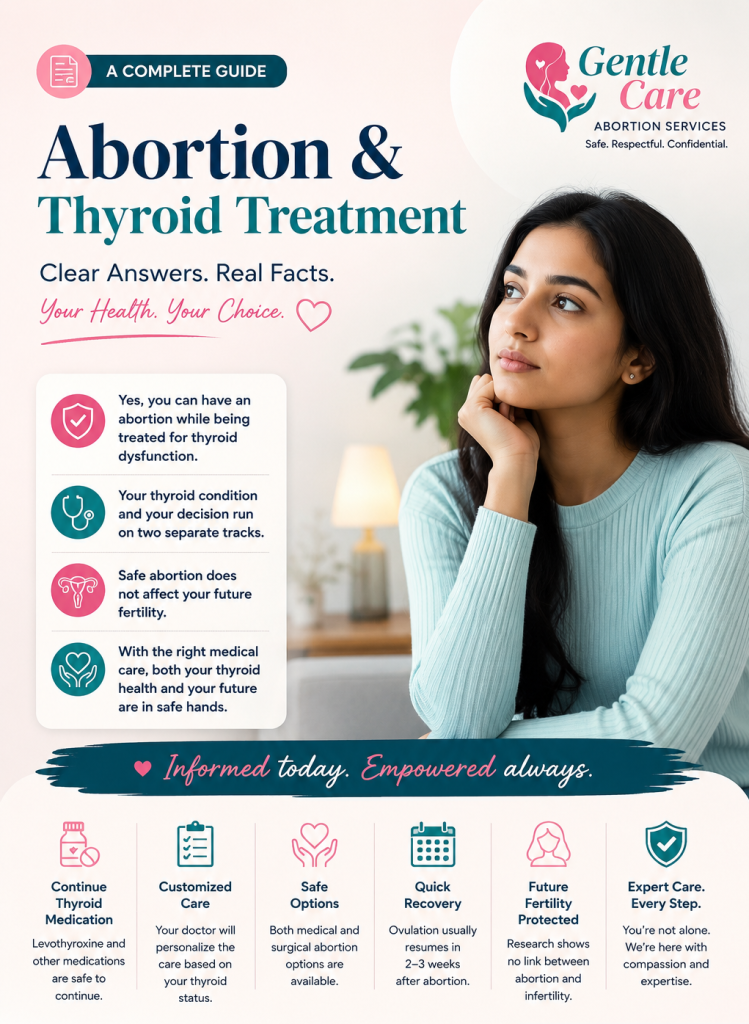
Yes. In the overwhelming majority of cases, being under treatment for thyroid dysfunction — whether that’s hypothyroidism, hyperthyroidism, or Hashimoto’s thyroiditis — does not stop you from safely terminating a pregnancy. Your thyroid condition and your decision about this pregnancy run on two separate tracks. And a good medical team manages both together instead of making you choose one over the other.
That said, “yes” doesn’t mean “without a conversation with your doctor.” A few details about your specific thyroid status change how your care team times and manages the procedure. But that doesn’t impact whether you can have it at all. Let’s walk through exactly what that means, along with everything else worth knowing before you decide.
Why Thyroid Treatment Isn’t the Roadblock to Your Abortion You Think It Is
Start with the scenario most women in this position actually face: hypothyroidism, managed with levothyroxine. This medication replaces a hormone your body already produces. Doctors consider it safe to continue right through pregnancy, delivery, or termination. In fact, they generally advise against stopping it under any of these circumstances. That’s because abruptly cutting it off causes far more problems than continuing it ever would.
Whichever abortion method you prefer or your doctor advises, medical or surgical, your levothyroxine dose keeps doing its job quietly in the background. Researchers haven’t identified any conflict between the medication and either abortion method.
Let’s now talk about hyperthyroidism.
Hyperthyroidism is where the conversation gets a little more layered. But the issue still isn’t the abortion itself. Rather, it’s whether your hormone levels are currently stable. Surgery under general anesthesia carries a rare but serious risk for people whose hyperthyroidism is poorly controlled. It’s a sudden hormonal surge called thyroid storm, triggered by the physical stress of the procedure.
It’s genuinely uncommon. Studies place the incidence at well under one case per 100,000 people annually [1]. But doctors take it seriously precisely because it can quickly turn dangerous when it happens. This is exactly why your care team will want to confirm your levels are stable before a surgical procedure. And it’s the same precaution any surgeon would take before any operation, not something unique to abortion.
Choose vacuum aspiration (suction abortion) instead or abortion pills if you are eligible. With mild sedation, anesthesia never enters the picture at all. It removes this particular concern almost entirely. In any case, your doctor should still know your full thyroid history either way, simply because complete information always leads to better care.
The takeaway: disclosing your thyroid treatment isn’t a confession that complicates your options. It’s information that helps your doctor choose the safest, smoothest path for you specifically.
Let’s Clear Up the Bigger Myth: Does Abortion Affect Future Fertility?
This is where a lot of the underlying fear actually lives. And it deserves a direct answer. The answer is ‘No’. A safe, legally performed abortion does not make you infertile. This isn’t a comforting guess. It’s backed by some genuinely striking research.
A major review by the US National Academies of Sciences found that first-time mothers who’d previously had an abortion were significantly less likely to need infertility treatment than women pregnant for the very first time — 1.95% compared to 5.14% [2].
Read that again: a prior abortion didn’t predict future infertility; if anything, the numbers ran in the opposite direction entirely. Leading medical bodies such as the American College of Obstetricians and gynecologists back this up with decades of research. The research clearly shows no connection between abortion — medical or surgical — and later difficulty conceiving. Most women ovulate again within two to three weeks of the procedure, meaning the body’s fertility cycle picks right back up almost immediately [3].
None of this means the procedure carries zero risk. And that’s purely because no medical procedure ever does. Rare complications like heavy bleeding can occur. Uncommonly, scarring inside the uterus (known as Asherman’s syndrome) has been linked to repeated surgical procedures, appearing in nearly 1.6% of cases in the research tracking it [3]. But a rare complication tied to a specific procedure type sits worlds away from “abortion closes the door on motherhood”.
So if worrying about a future pregnancy is holding you back, then, the evidence points the other way firmly.
Your Options, Explained Without the Medical Jargon
India’s Medical Termination of Pregnancy (MTP) Act makes abortion legal and accessible. And it’s worth knowing the actual shape of the law rather than operating on rumor or half-remembered WhatsApp forwards. Termination is legal up to 20 weeks of pregnancy with the approval of a single registered doctor.
Between 20 and 24 weeks, the law still allows it for specific circumstances — including contraceptive failure. One more thing is that contraceptive failure is a category that now applies equally to married and unmarried women — though this window requires sign-off from two doctors instead of one.
Confidentiality, meanwhile, isn’t just a courtesy your clinic extends. Now, the law mandates it, with real penalties for any provider who breaches it.
Within that legal window, two broad paths exist:
Medical abortion combines two medications, mifepristone followed by misoprostol. It typically works as an option up to around nine weeks of pregnancy. Depending on your doctor’s protocol, it happens at home or in a clinical setting. It involves no anesthesia, and carries a high success rate when a doctor properly supervises the process.
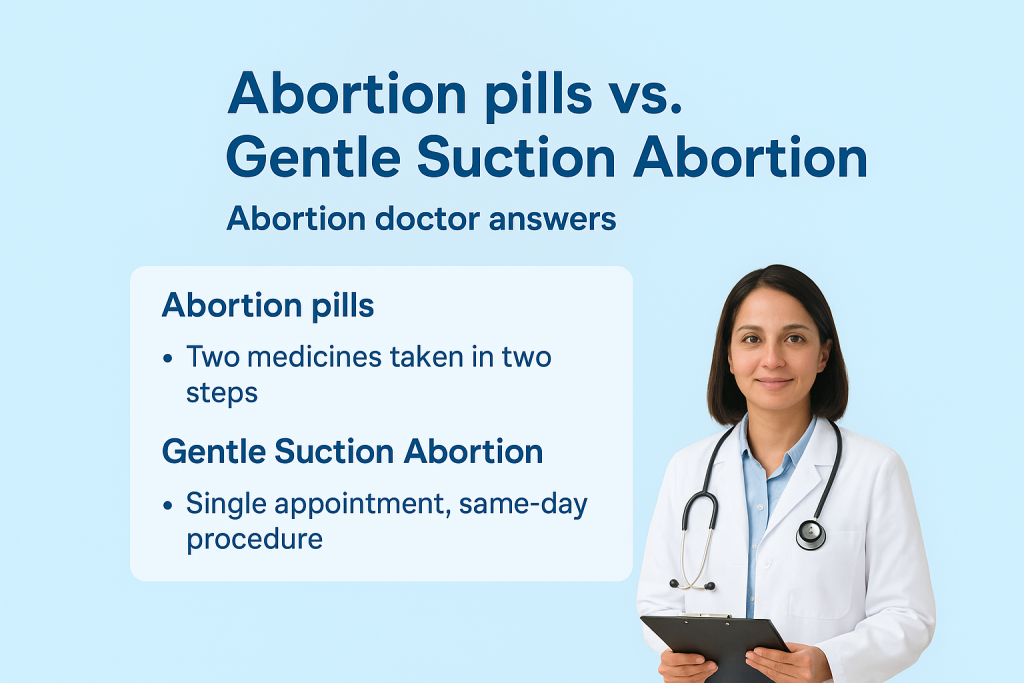
Procedural abortion covers methods such as vacuum aspiration, generally used further along in pregnancy or when a medical abortion isn’t suitable. It involves a clinical procedure, sometimes paired with light sedation or anesthesia depending on gestational age and method.
Here’s the part that should ease your mind either way: neither method interferes with your thyroid gland or the medication treating it. Your levothyroxine or antithyroid medication continues exactly as prescribed before, during, and after the procedure. These two parts of your health run in parallel, never in conflict.
What Pregnancy Itself Does to Your Thyroid (Whichever Path You Take)
Since you’re already paying close attention to your thyroid, two more things are worth knowing. You should know these regardless of what you ultimately decide because pregnancy affects thyroid function on its own, independent of any pre-existing condition you’re managing.
Transient Thyrotoxicosis
Early pregnancy floods the body with a hormone called hCG, which happens to resemble TSH (the hormone that regulates your thyroid) closely enough to give the gland a mild, temporary nudge.
Doctors call this gestational transient thyrotoxicosis. It occurs in approximately 1-3% of pregnancies [4]. Clinically, it is seen more often when significant nausea and vomiting are involved, since the two tend to travel together. It’s usually harmless. Also, it resolves on its own by the end of the first trimester as hCG levels decline. So, the condition rarely needs treatment. Think of it as your body’s chemistry reacting to a hormone surge, not a sign that something has gone wrong.
Postpartum Thyroiditis
Then there’s a lesser-known one: postpartum thyroiditis. It is a temporary inflammation of the thyroid that appears in roughly 5 to 10% of women within a year after a pregnancy ends [5].
Here’s the detail almost nobody mentions: despite the name, it isn’t limited to women who carry to term. Medical literature has documented it following miscarriage and induced abortion too. The condition reflects how the immune system recalibrates once a pregnancy ends, rather than to childbirth specifically.
It tends to move through a pattern. The first phase involves a brief hyperthyroid phase occurring in the first few months. Then, it is sometimes followed by a hypothyroid phase around four to eight months out. Finally, it resolves on its own within a year for most women. However, some women, especially those already carrying thyroid antibodies, go on to need longer-term treatment.
But none of this warrants alarm. It’s simply useful to recognize if fatigue, mood dips, or weight shifts show up months later and you’re tempted to write them off as “just life being busy.”
The point of mentioning both: your thyroid doesn’t go quiet just because a pregnancy ends, one way or another. Staying on top of it afterwards, whichever direction you choose, counts as good self-care either way.
Please, Don’t Try to Handle Your Abortion Alone
If this article leaves you with only one takeaway, let it be this: whatever you decide, decide it with a doctor involved. And not with a strip of abortion pills bought off a pharmacy counter or a website with zero medical oversight behind it or any traditional method like consuming lots of papaya to induce miscarriage or pineapple for abortion.
This isn’t scare tactics; it’s what the data from India’s own hospitals shows. Unsafe abortion accounts for an estimated 8% of the country’s maternal deaths [6]. And by one clinical estimate, it contributes to roughly thirteen deaths a day nationwide.
One hospital-based study following women who’d self-administered abortion pills without a prescription found that just 5.6% actually achieved a complete abortion. This means everyone else ended up with a failed, incomplete, or missed abortion. Furthermore, many needed emergency surgery afterwards to fix what had gone wrong. Self-medicating doesn’t only risk your safety; a large share of the time, it simply doesn’t work.
And here’s the piece that applies specifically to you: self-administered pills can’t rule out an ectopic pregnancy (one developing outside the uterus, which turns life-threatening if missed), can’t confirm exactly how far along you are, and can’t account for your thyroid status at all — three things a proper medical consultation checks as a matter of routine. Combine uncontrolled thyroid dysfunction with a self-managed abortion and zero supervision, and you’ve stacked two separate risk factors on top of each other with nobody monitoring either one.
India’s MTP Act allows only a registered medical practitioner to prescribe abortion medication, and it requires approved facilities to keep surgical backup on hand in case anything doesn’t go as expected. That requirement isn’t bureaucracy for its own sake — it’s precisely the safety net that self-medication removes.
What Actually Protects Your Future Fertility
If part of what’s weighing on you is fear about a baby you might want someday, here’s a reframe worth sitting with. Your fertility later depends far more on how well your thyroid gets managed than on what happens with this particular pregnancy.
Thyroid dysfunction is a manageable, long-term condition, not a one-time opportunity that vanishes the moment you don’t take it. Whether you’re on levothyroxine for hypothyroidism or antithyroid medication for hyperthyroidism, staying consistent with treatment and getting your levels checked regularly is what keeps your fertility on track.
That’s the genuinely good news in all of this. It means you get to make this decision based on what’s right for you right now, without treating it as a referendum on motherhood forever.
If You’re Ready to Talk to Someone
You don’t have to sort through any of this alone. Also, you don’t have to choose between managing your thyroid and making an abortion decision.
At Bangalore Genesis Hospital, we provide safe, legal abortion care. Our abortion team takes care of your existing medical conditions, including thyroid dysfunction, when guiding you across your available options. To ensure that you have a safe abortion and no post-abortion long-term health effects, we also advise getting certain diagnostic tests before we begin the abortion procedure.
We also advise you not to avoid the diagnostic tests that your doctor may ask of you before the procedure only to cut the abortion cost. Cutting corners while making healthcare decisions puts you at a greater risk of unmanageable complications later, including long-term health concerns.
Furthermore, our hospital offers you an environment where your privacy stays protected by law and by our own practice. Whether you need a same-day consultation, a second opinion, or simply someone to walk you through your options without judgment, our team is here for exactly that.
Contact us for a confidential and non-judgmental consultation.
Whatever you decide, decide it with accurate information and a doctor in your corner — not alone, and not on a deadline set by fear.
Disclaimer: This article is for general information and does not replace individualized medical advice. Every pregnancy and every thyroid profile is different — please consult your doctor to discuss what applies to your specific situation.
References:
- Journal of Clinical Endocrinology & Metabolism
- https://www.ncbi.nlm.nih.gov/books/NBK507237/
- https://pubmed.ncbi.nlm.nih.gov/33462894/
- https://www.ncbi.nlm.nih.gov/books/NBK559203/
- https://my.clevelandclinic.org/health/diseases/15294-postpartum-thyroiditis
- https://journals.lww.com/ijph/fulltext/2024/01000/recent_amendment_in_the_medical_termination_of.25.aspx
Related Posts:
- Can abortion cause infertility: What experts have to say?
- Can You Get Pregnant With PCOS? What if it’s an Unwanted Pregnancy?
- Light Bleeding After Unwanted Kit can be Terrifying. We Know
- Can Doctor Deny You Abortion in India if You’re Unmarried?
- PCOS is Now PMOS: Breaking the “Rasauli” Stigma & Navigating Unplanned Pregnancy
Quick Links:
- Late Period? Understanding the ‘Why’ Behind & ‘What Next’?
- Morning After Pill vs. Unwanted Kit: Knowing Your Timeline and Your Rights
- Motherhood Is a Choice: Respecting Every Woman’s Right to Choose
- 6 Condom Myths That Lead to Surprise Pregnancies
- The ₹1.06 Lakh Protection: What Happens When Plan Goes Wrong
