
Contents of This Post:
- You Took the Pills—Now the Waiting Begins.
- No Bleeding, Light Bleeding, or Heavy Bleeding: What’s Actually Normal After Unwanted Kit?
- When Little or No Bleeding Could Mean Something More Than “The Pills Need Time”.
- Already Taken the Abortion Pills? Here’s What You Should Do Right Now
- Thinking About Buying an Unwanted Kit? Read This Before You Take the First Pill.
- Why Doctors Often Recommend Other Abortion Methods Instead of Abortion Pills
- Trying to Save Money or Keep Things Private? Here’s What Many Women Learn Too Late
Scared Because You’re Not Bleeding After Taking Unwanted Kit? Start Here
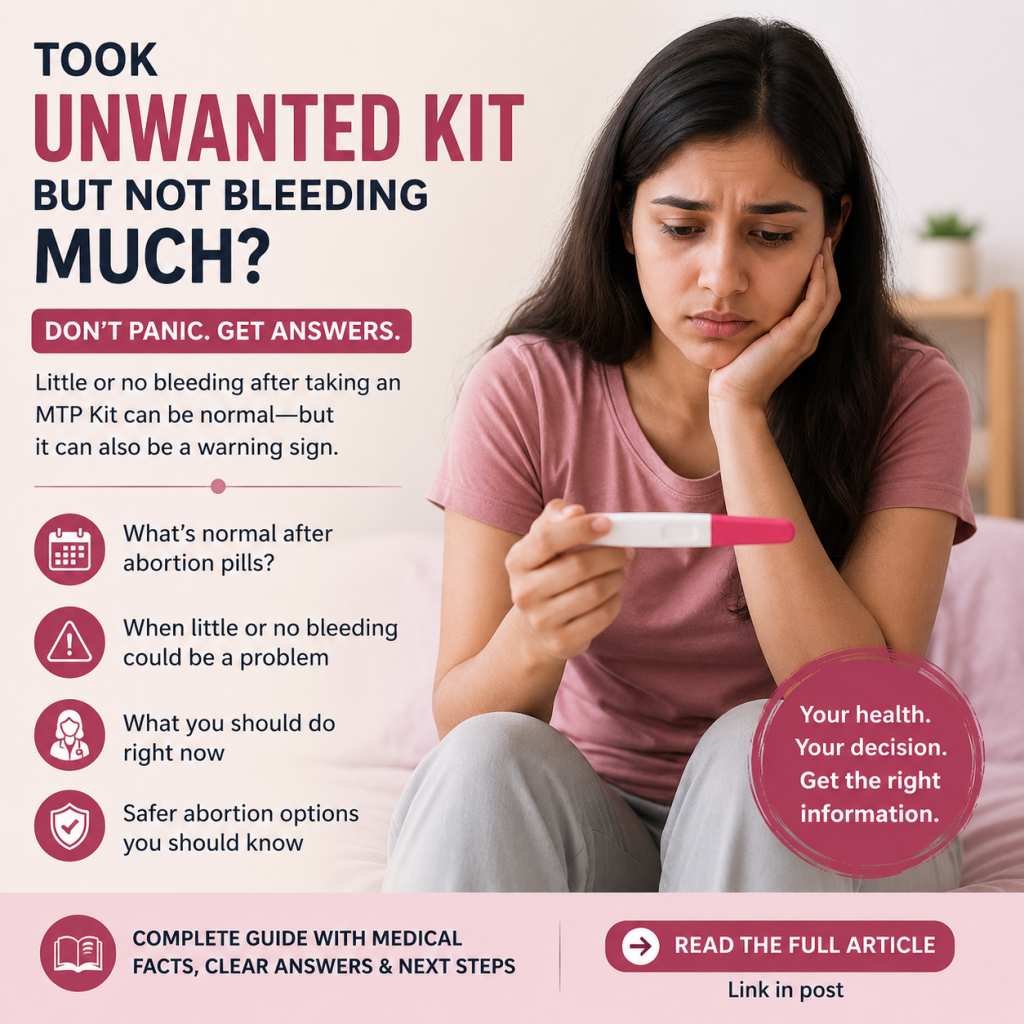
You took the Unwanted Kit or a similar MTP Kit. You expected bleeding. Maybe you even kept checking every hour, waiting for something to happen. But instead of heavy bleeding, you’re seeing only a few spots. Or perhaps you’re not bleeding at all.
Naturally, questions start racing through your mind. Did the abortion pills work? Did I take them correctly? Do I need another dose? Is something wrong with the pregnancy? Should I wait longer or see a doctor right away?
If you searched “no bleeding after taking Unwanted Kit” or “little bleeding after Unwanted Kit”, you’re not looking for textbook information. You want to know what is happening in your body and what you should do next.
The news you are going to like at this moment is that no bleeding immediately after taking an MTP kit does not always mean something has gone wrong. At the same time, it is not something you should ignore. The amount of bleeding, the timing, your pregnancy duration, your medical history, and even the location of the pregnancy can all influence what happens after taking abortion pills.
Let’s begin by answering your concerns that have made the situation quisquous for you.
You Took the Abortion Pills. Now the Waiting Begins.
One of the biggest misconceptions about abortion tablets is that bleeding starts immediately after taking them.
In reality, the process takes time.
To understand why, it helps to know how Unwanted Kit works. The kit contains two different medicines, going by the names Mifepristone and Misoprostol that work together to end a pregnancy.

The first pill, mifepristone, has the target of blocking the hormone progesterone. By doing so, the pregnancy gets deprived of it and cannot continue to grow. Nearly 8 out of every 10 women taking abortion medicines notice little or no change after taking this tablet. Some may experience mild spotting, while others may not experience any symptoms at all. They often continue working as usual until they take the next tablets, which is usually scheduled after 24-48 hours.
The second medicine, misoprostol, now does the major part of the job by causing the uterus to contract and expel the pregnancy tissue. This is the stage that usually triggers bleeding and cramping.
Even then, every woman responds differently.
Some women begin bleeding within a few hours of taking misoprostol. Others may take longer. The intensity of bleeding can also vary considerably. One woman may experience heavy bleeding with clots, while another may notice lighter bleeding despite the abortion being successful.
This uncertainty is exactly why many women become anxious when the bleeding doesn’t match what they expected.
However, before assuming that the pills have failed, it is important to consider a few factors.
The Timing Matters
If you recently took misoprostol, your body may need more time to respond. Not everyone starts bleeding at the same rate.
On the other hand, if many hours (approx. 8-10 hours) or even days have passed and you have experienced little or no bleeding, the situation deserves closer attention.
Pregnancy Duration Matters
Abortion pills generally work best during early pregnancy (maximum efficiency up to 6 weeks of pregnancy). However, as pregnancy progresses, the body’s response to the abortion medicines can become less predictable.
Women who take abortion pills without first confirming the exact gestational age sometimes discover that they were further along in pregnancy than they believed. Many women do not know that when they first discover they are pregnant, they are already 4 or 5 weeks pregnant. The gestation length starts from the first day of the last period, known as the Last Menstrual Period (LMP) date. So, pregnancy calculation starts even before you conceive.
This can affect both the effectiveness of the pills and the symptoms they experience afterwards.
Your Health Matters Too
Not every woman is an ideal candidate for abortion pills.
Doctors usually evaluate factors such as medical history, current medications, bleeding disorders, severe anemia, and other health conditions before prescribing an MTP kit. Without this assessment, a woman may expose herself to risks that she never anticipated. This is one of the main reasons why self-administering any MTP kit, including Mankind Unwanted Kit without medical supervision can become complicated.
At this point, you may be wondering whether your bleeding pattern falls within the normal range or whether it could indicate a problem. That’s exactly what we’ll explore now.
No Bleeding, Light Bleeding, or Heavy Bleeding: What’s Actually Normal After Unwanted Kit?
If you’ve reached this point, you’re probably trying to answer one simple question:
“Is what I’m experiencing normal?”
The truth is that there is no single bleeding pattern that every woman experiences after taking an Unwanted Kit. While bleeding is an expected part of the abortion process, the amount, timing, and duration can vary significantly from one person to another.
That said, there are some general patterns that doctors consider normal after taking abortion pills.
When Does Abortion Bleeding Usually Start?
Most women begin bleeding after taking the misoprostol tablets, which are usually taken 24 to 48 hours after mifepristone.
Bleeding often starts within a few hours of taking misoprostol. However, some women may notice bleeding sooner, while others may experience a delay, that can range between 4 hours to 24 hours. This variation alone does not necessarily indicate that the abortion has failed.
In addition to bleeding, many women experience cramping, which is a sign that the uterus is contracting to expel pregnancy tissue.
What Does Normal Bleeding Look Like?
For many women, bleeding after abortion pills is heavier than a regular menstrual period.
You may notice:
- Bright red bleeding
- Blood clots of varying sizes
- Cramping that comes and goes
- Tissue passing from the vagina
- Bleeding that gradually becomes lighter over time
After the heaviest bleeding passes, spotting or light bleeding may continue for several days or even a few weeks. While this experience is common, it is not the only normal experience.
Can Light Bleeding Still Be Normal?
Yes, sometimes.
Some women experience lighter bleeding than they expected and still have a successful abortion. This is more likely when the pregnancy is very early (4-5 weeks).
However, light bleeding should always be interpreted alongside other factors, such as:
- How far along the pregnancy is.
- Whether cramping occurred.
- Whether pregnancy symptoms are improving.
- Also, whether an ultrasound has confirmed that the pregnancy has passed.
This is why bleeding alone cannot confirm whether an abortion is complete. A woman may experience significant bleeding and still have retained pregnancy tissue. Likewise, another woman may experience relatively light bleeding and have a complete abortion.

What About Spotting Only?
Spotting refers to very light bleeding that may appear as a few drops of blood on underwear or a sanitary pad. A small amount of spotting immediately after taking the medications may not be concerning. However, if spotting remains the only symptom and substantial bleeding never develops, further evaluation may become necessary. This is especially true if pregnancy symptoms continue or if the pregnancy test remains positive several weeks later.
Is No Bleeding Ever Normal?
This is where many women become concerned. If only a short time has passed since taking misoprostol, the body may still be responding to the medication. However, if you have experienced no bleeding after taking Unwanted Kit, particularly after the expected timeframe has passed, you should not assume that everything is fine.
No bleeding can sometimes indicate that:
- The medications have not worked as expected.
- Or the pregnancy may still be ongoing.
- It can even mean that the pregnancy may be located outside the uterus (ectopic pregnancy).
- Or the pregnancy duration may have been calculated incorrectly.

Importantly, abortion pills do not effectively treat an ectopic pregnancy. In such cases, waiting for bleeding to start can delay necessary medical care.
When Is Bleeding Considered Too Heavy?
While many women worry about not bleeding enough, excessive bleeding can also be a problem.
Seek immediate medical attention if you:
- Soak two or more large sanitary pads per hour for two consecutive hours.
- Feel dizzy, faint, or extremely weak.
- Experience shortness of breath.
- Notice signs of severe blood loss.
Heavy bleeding can become especially dangerous for women who already have anemia, blood clotting disorders, or certain underlying medical conditions.
Bleeding Alone Doesn’t Tell the Whole Story
This is perhaps the most important point to remember.
Many women judge the success of abortion pills entirely by the amount of blood they see. Unfortunately, that is not the true and the only criterion because the body doesn’t work that way. Bleeding provides clues, but it does not provide all the answers.
That’s why doctors often rely on additional information such as symptoms, follow-up examinations, pregnancy tests, and ultrasounds when confirming whether an abortion is complete.
So, if little bleeding does not automatically mean failure and heavy bleeding does not automatically mean success, what could actually be causing little or no bleeding after taking Unwanted Kit?
Let’s look at the most important possibilities next.
When Little or No Bleeding Could Mean Something More Than “The Pills Need Time”
A small delay in bleeding does not automatically mean the pills have failed. Still, when bleeding stays very light or never starts at all, it can point to a few possibilities that need attention rather than guesswork.
Incomplete Abortion
One possibility is that the abortion is incomplete, which means some pregnancy tissue remains inside the uterus. Medical sources note that retained tissue can require follow-up care, and persistent or heavy bleeding can be a sign that the abortion did not finish as expected.
Failed Abortion
Another possibility is that the pregnancy is still ongoing. When that happens, the body may not respond the way a woman expects after taking the pills, and follow-up is needed to confirm whether the pregnancy has ended. In practice, clinicians may use an ultrasound or a pregnancy test after the abortion to check completion.
Ectopic Pregnancy
A more urgent possibility is an ectopic pregnancy, which means the pregnancy is outside the uterus. Abortion pills do not treat ectopic pregnancy, and delayed diagnosis can be dangerous because rupture can cause major internal bleeding and become a life-threatening emergency. Abnormal bleeding and pelvic pain are warning signs that should not be brushed aside.
Sometimes the issue is simply that the pregnancy was dated incorrectly. If the pregnancy is farther along than expected, the pills may be less predictable, which is why ultrasound or a clinical assessment is often used to confirm gestational age before treatment.
There is also the very practical possibility that the medicine was not absorbed properly. For example, if a person vomits soon after taking mifepristone, the treatment may be less likely to work and may need medical advice.
So, little bleeding is not a diagnosis by itself. It is a clue. The real question is whether the pills worked, whether the pregnancy is continuing, or whether another condition is hiding underneath the symptoms. That is why the next step should not be more guessing. It should be a proper check.
Already Taken the Pills? Here’s What You Should Do Right Now
If you’ve already taken Unwanted Kit and the bleeding isn’t what you expected, don’t rush to conclusions. At the same time, don’t keep waiting indefinitely without a plan. The best approach is to monitor your symptoms, understand what is happening, and know when it is time to seek medical care.
First, Check the Clock
Ask yourself:
- When did you take mifepristone?
- When did you take misoprostol?
- How many hours have passed since taking misoprostol?
Many women start worrying within the first few hours. However, the body does not always respond on a strict schedule. If only a short time has passed since taking misoprostol, it may be reasonable to wait a little longer while monitoring your symptoms.
Gentle Movement May Help
Many women spend the entire day in bed after taking abortion pills because they expect severe pain or heavy bleeding. While rest is important if you do not feel well, complete inactivity is not always necessary.
A gentle walk around your room, moving around the house, or carrying out light daily activities may help your body respond naturally. Some women notice that cramping and bleeding begin after they start moving around.
However, avoid:
- Strenuous exercise
- Heavy lifting
- High-intensity workouts
- Activities that leave you exhausted
Think gentle movement, not a fitness challenge.
Stay Hydrated and Nourished
Cramping, anxiety, and the anticipation of bleeding can make many women forget basic self-care.
Try to:
- Drink enough water.
- Eat light, nutritious meals.
- Avoid skipping meals.
- Get adequate rest.
Your body is going through a medical process. Supporting your overall health can help you cope better with the symptoms.
Monitor More Than Just Bleeding
Many women focus exclusively on the amount of blood they see.
Instead, pay attention to the bigger picture:
- Are you experiencing cramping?
- Do you experience your pregnancy symptoms changing?
- Are you feeling generally well?
- Has any bleeding started, even if it is light?
These details can help a doctor understand what may be happening if you need medical advice later.
Don’t Keep Taking Extra Pills on Your Own
This is one of the most common mistakes women make after searching online.
When bleeding does not start as expected, some women assume the pills have failed and purchase another MTP kit without consulting a doctor.
Unfortunately, taking additional abortion pills without proper evaluation can create new problems. If the pregnancy is ectopic, for example, more pills will not solve the problem. If the abortion is incomplete, the solution may not be another round of medication.
Before taking any additional medication, seek professional advice.
Take a Pregnancy Test at the Right Time
Another common mistake is taking a pregnancy test too soon after taking the pills. Pregnancy hormones can remain in the body for several weeks after a successful abortion. As a result, an early pregnancy test may still show a positive result even when the abortion has worked.
Your doctor can advise you on the appropriate timing for follow-up testing based on your situation.
When Should You Arrange an Ultrasound?
An ultrasound becomes particularly important if:
- Bleeding never starts.
- Bleeding remains extremely minimal.
- You experience a weird bleeding pattern, sometimes normal, sometimes stopped altogether only to start again, even if it is mild spotting.
- Pregnancy symptoms continue.
- You develop severe pain.
- You are uncertain about whether the abortion is complete.
An ultrasound can provide answers that symptoms alone cannot.
Seek Immediate Medical Attention If You Experience:
- Severe abdominal pain that does not improve.
- Pain concentrated on one side of the abdomen.
- Dizziness or fainting
- Shoulder-tip pain
- Excessively heavy bleeding
- Fever or signs of infection
- Severe weakness or breathlessness
These symptoms should never be ignored, regardless of how much bleeding you are experiencing.
The Goal Is Answers, Not Guesswork
If there is one takeaway from this section, it is this: avoid making decisions based solely on the amount of bleeding you see.
A little patience may be appropriate in some situations. However, repeated internet searches, self-diagnosis, and additional unsupervised doses of abortion pills rarely provide clarity.
Instead, monitor your symptoms carefully, support your body with rest and hydration, and seek medical evaluation when something doesn’t feel right.
This brings us to an important question: if abortion pills can sometimes leave women confused, anxious, and uncertain about what is happening, why do so many women still take an MTP kit without medical supervision in the first place—and what risks does that decision carry?
Thinking About Buying an Unwanted Kit? Here’s What You Should Know First
If you’re reading this before taking an Unwanted Kit, this section could save you from the uncertainty, stress, and complications that many women face after self-administering abortion pills.
Every day, women search for terms like “buy Unwanted Kit,” “purchase Unwanted Kit,” or “MTP kit without prescription.” Some are trying to save money. Others want privacy. Many simply want a quick solution.
For unmarried women, the reasons can be even more personal. Fear of judgment, concerns about family reactions, relationship pressures, or misconceptions about abortion laws often push them toward self-managing the process.
However, what many women don’t realize is that the real risk is not the abortion itself. The real risk is taking abortion pills without knowing whether they are the right option for your pregnancy and your health.
Why Don’t Doctors Prescribe Abortion Pills to Everyone?
Because not every pregnancy is suitable for medical abortion.
Before recommending abortion pills, doctors typically assess:
- How many weeks pregnant you are.
- Whether the pregnancy is inside the uterus.
- Your medical history.
- Current medications.
- Previous surgeries or pregnancy complications.
- Conditions such as severe anemia or bleeding disorders.
Without these checks, you are essentially taking medication without knowing whether it is appropriate for your situation.
The Biggest Risk: Missing an Ectopic Pregnancy
One of the most serious dangers of self-administering an MTP kit is an undiagnosed ectopic pregnancy. An ectopic pregnancy is the one that starts growing anywhere else outside the uterus, most commonly in a fallopian tube, but can also reach the abdominal cavity, attach to the ovary wall or cervix lining, etc.
This matters because abortion pills do not treat ectopic pregnancies.
A woman may take the pills, wait for bleeding, assume everything is progressing normally, and miss the warning signs of a growing ectopic pregnancy. If the pregnancy ruptures, it can cause severe internal bleeding and become a medical emergency.
This is one reason why doctors recommend an ultrasound before proceeding with an abortion.
Incomplete Abortion: The Complication Behind Many Emergency Visits
When women search for “little bleeding after Unwanted Kit” or “no bleeding after taking Unwanted Kit,” one of the concerns doctors consider is incomplete abortion. In simple terms, the abortion process starts but does not fully finish.
Some pregnancy tissue remains inside the uterus, which can lead to:
- Continued bleeding
- Persistent pregnancy symptoms
- Pain and cramping
- Infection
- The need for additional treatment
In many cases, women who hoped to avoid a clinic visit eventually require medical attention anyway.
Heavy Bleeding Isn’t Equally Safe for Everyone
Abortion pills cause bleeding by design. However, not every woman can tolerate blood loss or even the cramping pain equally well.
Women with:
- Moderate to severe anemia
- Blood clotting disorders
- Certain chronic illnesses
- Some medication-related conditions
may face greater risks if significant bleeding occurs.
This is another reason why medical assessment matters. What may be a routine abortion for one woman could become a much more complicated experience for another.
The Hidden Cost of a “Cheaper” Abortion
Many women choose abortion pills because they believe it will reduce the cost of abortion.
Sometimes it does.
Sometimes it doesn’t.
A successful medical abortion may cost less than a procedural abortion. However, if complications arise, expenses can increase rapidly.
The original cost of the MTP pills may be followed by:
- Ultrasound examinations
- Multiple clinic visits
- Additional medications
- Emergency consultations
- Treatment for incomplete abortion
- Surgical evacuation if required
What initially appeared to be the cheaper option can quickly become the more expensive one.
Abortion Is Legal for Unmarried Women in India
Many women are surprised to learn this.
Under current abortion laws in India, unmarried women can legally access abortion services under specified conditions. You do not need your partner’s consent, and you do not need permission from your family to seek abortion care if you are an adult.
Yet fear and stigma still lead many women to manage the process entirely on their own.
Unfortunately, avoiding one uncomfortable conversation can sometimes create a much bigger medical problem.
A Better Question Than “Where Can I Buy an Unwanted Kit?”
Instead of asking:
“Where can I buy an Unwanted Kit?”
consider asking:
“Am I actually a suitable candidate for abortion pills?”
That single question can make all the difference.
A doctor may determine that abortion pills are appropriate for you. If so, you’ll proceed with far greater confidence and safety.
On the other hand, you may discover that another option would be quicker, more effective, and more predictable for your particular pregnancy.
Why Doctors Often Recommend Other Abortion Methods Instead of Abortion Pills
For many women, abortion pills feel like the simplest path because they seem private, fast, and easy to obtain. But in real practice, that is not always the safest or most efficient option.
That is why doctors often look at the pregnancy first and then decide which method fits best. In many cases, another abortion method may offer more certainty, less waiting, and fewer surprises.

Vacuum Aspiration Can Be Quicker and More Predictable
For first-trimester pregnancies, suction abortion, also called vacuum aspiration, is often a strong option.
It is a procedure done under medical supervision, and in many clinics it can be completed in a single appointment. That makes it very different from abortion pills, where the process may unfold over several hours or even days and still leave room for uncertainty.
Many women prefer suction abortion because:
- The procedure is usually brief.
- The outcome is more immediate.
- Bleeding patterns are generally more predictable.
- There is less confusion about whether the abortion is complete.
This can be especially helpful for women who want clarity rather than the long waiting period that sometimes follows abortion pills.
When Pregnancy Is Further Along, Other Methods May Be Needed
Abortion care is not one-size-fits-all.
As pregnancy advances, doctors may recommend different procedures based on how far along the pregnancy is and what is medically appropriate. In later-stage pregnancies, options may include procedures such as dilation and evacuation, or in some cases labor induction under medical supervision.
The key point is simple: the best method depends on the pregnancy stage and the woman’s health, not just convenience.
Why This Matters More Than It First Appears
Many women start by thinking only about privacy or price. That is understandable. But the method chosen can change the whole experience.
A poorly matched abortion method can mean:
- More stress
- Furthermore uncertainty
- More follow-up visits
- More pain or bleeding than expected.
- Finally, higher overall cost if complications develop
So the real question is not just, “Which option is easiest to buy?” It is, “Which option is safest and most suitable for me?”
A Doctor Can Help Match the Method to the Situation
Before recommending any abortion method, a doctor can check the pregnancy, confirm the stage, and look for factors that might make one option better than another.
That evaluation matters because it can prevent problems before they begin.
For some women, abortion pills are appropriate. For others, suction abortion is a better fit. But for later pregnancies, a different procedure may be the right option altogether. The important thing is to make that decision with medical guidance instead of internet guesswork.
The Better Path Is Often the More Certain One
When women fear stigma, secrecy, or cost, it is easy to reach for the fastest option. But fast is not always better.
A more certain method can save time, reduce uncertainty, and lower the chance of a botched abortion that ends up costing more than expected.
That is why, before buying an Unwanted Kit, it makes sense to pause and ask one practical question: is there a safer, simpler option for my situation?
In many cases, the answer may be yes.
Trying to Save Money or Keep Things Private? Here’s What Many Women Learn Too Late
Let’s be honest.
Most women who buy an Unwanted Kit without consulting a doctor are not being careless. They are usually trying to solve a problem in the quickest, most practical way possible.
Some want to avoid the cost of a clinic visit.
Some are worried about privacy.
Others fear being judged by family members, partners, or society.
For unmarried women especially, the pressure can feel overwhelming. The fear of someone finding out about the pregnancy often becomes greater than the fear of taking abortion pills without medical supervision.
As a result, many women convince themselves that purchasing an MTP kit from a pharmacy is the simplest solution.
Unfortunately, this decision can sometimes create the very problems they were trying to avoid.
The Cheapest Option Can Become the Most Expensive One
At first glance, abortion pills may appear to be the most affordable abortion method.
After all, buying a kit costs less than visiting a clinic, right?
Not always.
When the abortion goes exactly as planned, the overall expense may remain low. However, if complications arise, the financial picture changes quickly.
A woman who develops an incomplete abortion may require:
- Ultrasound examinations
- Follow-up consultations
- Additional medications
- Emergency treatment
- A suction procedure to complete the abortion
In other words, the original cost of the abortion pills can become only the beginning of the total expense.
Many women who hoped to save money ultimately spend far more than they would have if they had sought medical guidance from the start.
Privacy Matters—But So Does Your Safety
Wanting privacy is completely understandable.
The good news is that seeking professional abortion care does not mean giving up your confidentiality.
Many women delay medical consultation because they believe that doctors will automatically inform family members, parents, partners, or employers. This fear often drives them toward self-managed abortion.
However, healthcare providers are expected to maintain patient confidentiality. Your medical information is not something that can be casually shared with others.
For unmarried women, this is especially important to understand.
Abortion Is Legal for Unmarried Women in India
One of the biggest reasons women secretly buy abortion pills is the mistaken belief that abortion is only available to married women.
That is not true.
Under Indian law, unmarried women can legally access abortion services under specified circumstances.
You do not need your partner’s permission.
Also, you do not need approval from your family.
You do not lose your right to safe medical care because of your marital status.
Yet every year, women continue to take unnecessary risks because they are unaware of these protections.
The Emotional Cost Is Often Overlooked
When people discuss the cost of abortion, they usually focus on money.
But there is another cost that rarely gets mentioned.
The uncertainty.
The endless internet searches.
Also, the sleepless nights wondering whether the pills worked.
And the fear that every cramp, every spot of blood, or every delayed symptom means something has gone wrong.
Many women spend days trapped between hope and panic because they do not have reliable medical guidance.
Sometimes, having a clear diagnosis, a treatment plan, and a doctor available to answer questions is worth far more than the money saved by avoiding a consultation.
The Goal Isn’t Just to End a Pregnancy. It’s to Do It Safely.
Whether you are considering abortion pills or another abortion method, the objective should never be to simply find the fastest or cheapest option.
The real goal is to end the pregnancy safely, effectively, and with as little physical and emotional stress as possible.
For some women, that may involve abortion pills prescribed after proper evaluation.
For others, a suction abortion may be the better choice.
The important thing is making an informed decision rather than a rushed one.
Because what many women learn too late is that the safest abortion is usually the one that begins with medical advice—not internet guesswork.
What to Remember Before You Decide
If you are still considering whether to take abortion pills on your own, remember this:
A doctor is not there just to hand out a prescription. The doctor is there to decide whether the pills are right for you, or whether another method would be safer, faster, and more effective.
That single step can protect you from a lot of unnecessary trouble.
And if you have already taken the pills, the next step is not panic. It is knowing what to watch for, what to avoid doing on your own, and when to get help. And if you are uncertain about your abortion’s progress, you can reach out to our abortion care team at Bangalore Genesis Hospital.
Also, if you are seeking a safe, legal and confidential way out of an unwanted pregnancy, whether married or unmarried, whether an Indian or a foreign woman, feel free to reach out to our team, who can help you decide what favours your health the best. Also, you can schedule a same-day discharge, single-appointment abortion in Bangalore.
Get in touch today.
Disclaimer: This post is for educational purposes only and does not replace professional medical advice. Always consult a qualified healthcare provider before taking any abortion medication.
Related Posts:
- Unwanted kit bleeding time: What you should know?
- Late Period? Understanding the ‘Why’ Behind & ‘What Next’?
- Morning After Pill vs. Unwanted Kit: Knowing Your Timeline and Your Rights
- How Much Rest is Necessary After an Abortion?
- Understanding What Your Menstrual Cycle Speaks & When it Seeks Attention
Quick Links:
- PCOS is Now PMOS: Breaking the “Rasauli” Stigma & Navigating Unplanned Pregnancy
- Can You Get Pregnant With PCOS? What if it’s an Unwanted Pregnancy?
- Motherhood Is a Choice: Respecting Every Woman’s Right to Choose
- 6 Condom Myths That Lead to Surprise Pregnancies
- The ₹1.06 Lakh Protection: What Happens When Plan Goes Wrong
