
Contents of This Post:
- A New Name, An Unchanged Reality, and a Shifting Perception
- Dismantling the “Rasauli” Myth and the Social Stigma
- The Pregnancy Paradox – Why PMOS Does Not Equal Infertility
- Setting the Record Straight – Does an Abortion Cause PMOS?
- Your Body, Your Choice – Compassionate and Confidential Care at Bangalore Genesis Hospital
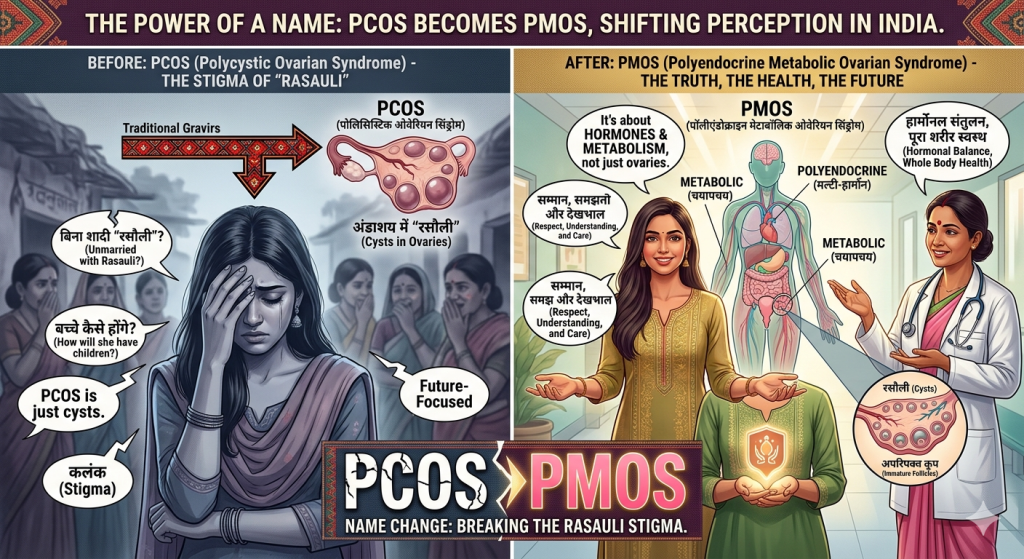
Let’s talk about a major change that just shook the medical world. Also, it is the one that directly impacts you, your sister, your wife, your best friend, or your colleague. For decades, both doctors and patients used the term PCOS (Polycystic Ovary Syndrome) to describe a complex condition affecting hormones and menstrual cycles. However, a massive global effort led by Monash University recently resulted in a historic decision published in The Lancet. Experts are officially renaming the condition to PMOS (Polyendocrine Metabolic Ovarian Syndrome). (Source)
A New Name, An Unchanged Reality, and a Shifting Perception
Today, global medical experts are officially replacing the outdated name PCOS (Polycystic Ovary Syndrome) with PMOS (Polyendocrine Metabolic Ovarian Syndrome).
Why did they change a name we’ve used for generations? Frankly, the old name was highly misleading. By focusing entirely on the word “cysts,” it incorrectly reduced a complex, full-body hormonal and metabolic issue down to a single reproductive organ. Consequently, society focused entirely on the ovaries, completely ignoring the underlying hormonal imbalance, including insulin resistance.
Now, let’s clear up a crucial detail right away: changing the name does not change the disease. The biological causes, genetic factors, and daily symptoms—such as insulin resistance, weight fluctuations, and unpredictable ovulation—remain unchanged. However, this reclassification completely alters the world’s perception of the condition. This shift carries profound weight in India, where medical labels heavily influence social status, family expectations, and a woman’s mental peace.
Ultimately, true empowerment comes from knowing your body and owning your choices. When you understand how PMOS genuinely impacts your fertility, you gain total control over your reproductive timeline. Whether you face an unexpected pregnancy and want to take it to full term, or you need to access a confidential, safe abortion in Bangalore, your medical diagnosis should never stand in the way of compassionate, judgment-free healthcare.
Dismantling the “Rasauli” Myth and the Social Stigma
Words hold immense power, and in India, outdated medical terminology often inflicts an unfair social burden. Recent medical data indicate that PMOS affects an astonishing 16% to 18% of women across India. Despite this incredibly high prevalence, society frequently wraps the condition in heavy layers of silence and shame.
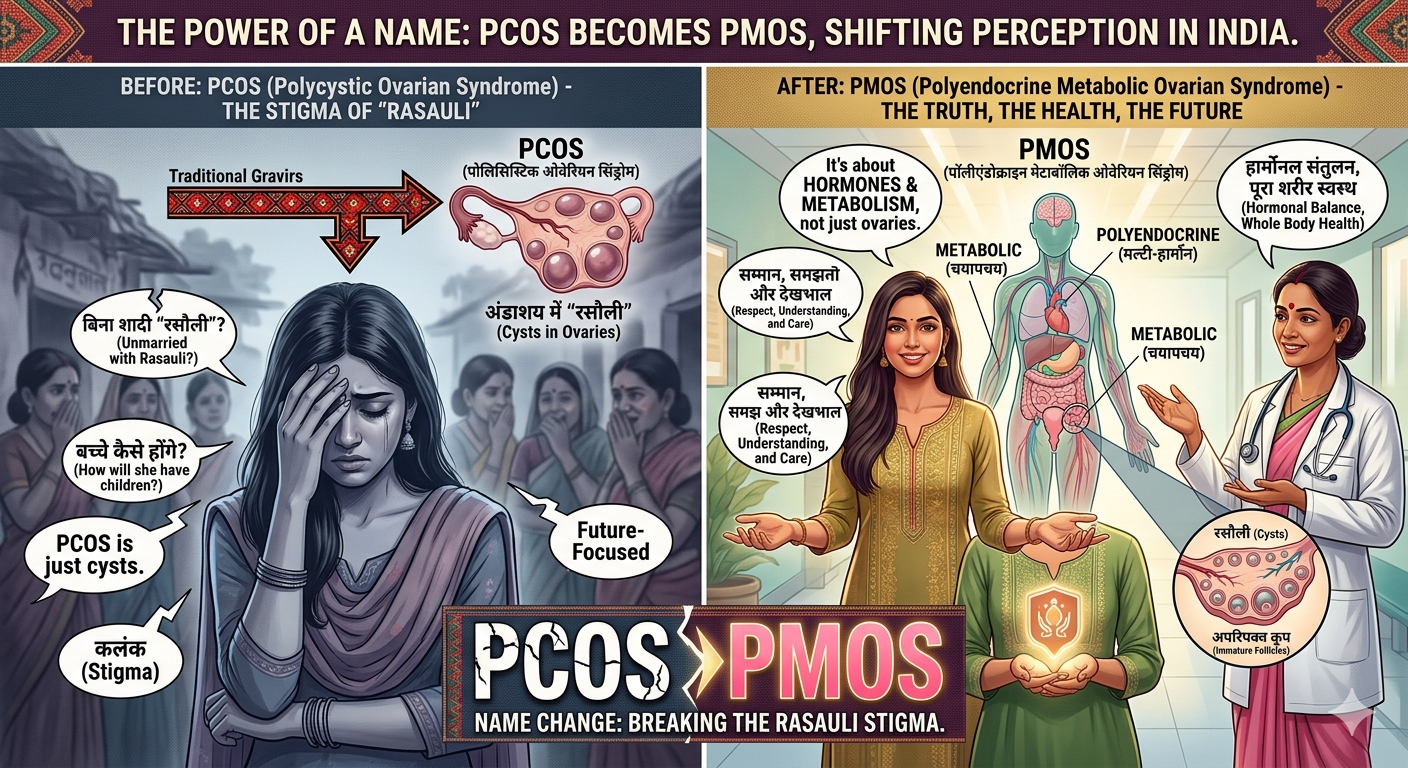
When an unmarried young woman receives a diagnosis, families and neighbours immediately translate the clinical word “cyst” into a dreaded Hindi equivalent: ‘Rasauli’.
This single translation triggers immediate social panic. In many Indian communities, people mistakenly equate a rasauli with severe physical tumours, permanent internal scarring, or absolute sterility. Consequently, young, unmarried girls face cruel, whispered judgments from extended family and society: “ इसके तो अंडाशय में रसौली है, शादी कैसे होगी? बच्चे कैसे होंगे?”
Fortunately, the transition to PMOS completely dismantles this toxic narrative.
Here is why the new name, PMOS, changes the game:
- Firstly, It Explodes the “Cyst” Lie: Decades of clinical research prove that women with this condition do not actually have abnormal, pathological cysts. Ultrasound scans merely show “arrested follicles”—perfectly normal egg sacs that simply stalled midway through maturation due to mismatched hormonal signals. Therefore, using the word ‘rasauli’, which means a pathological cyst in Hindi, is scientifically wrong.
- Secondly, It removes the Fertility Trap: Because the old name spotlighted the ovaries, society assumed the condition was a fundamental reproductive failure. By introducing “Polyendocrine” and “Metabolic,” the new name proves that the root cause lies in full-body hormone pathways and insulin regulation, not a broken reproductive system.
- Finally, It Protects Unmarried Women: Shifting the conversation toward metabolic health—much like managing a thyroid imbalance—safeguards young women from marriage-related shaming and unnecessary isolation.
No matter your marital status, you deserve to manage your body without fear of finger-pointing. Unplanned pregnancies can happen to anyone, and global public health statistics reveal a sobering reality: 1 in 7 unplanned pregnancies worldwide occurs right here in India.
When faced with an unexpected pregnancy, fear of the rasauli stigma or societal pressure should never force you into making a panicked decision. Realising that this is a common metabolic health condition—not a reflection of your worth—can help you approach confidential medical care with confidence, including safe abortion services in Bangalore, without fear, shame, or judgment.
The Pregnancy Paradox – Why PMOS Does Not Equal Infertility?
Many people hold a deeply ingrained and dangerous belief that women with PMOS (formerly PCOS) are completely infertile. In fact, society frequently tells young women with irregular cycles that they can never conceive naturally. This sweeping assumption creates a false sense of security, leading many to skip regular contraceptive measures.
However, medical science paints a completely different picture. While PMOS certainly alters your ovulation patterns and can make tracking your cycle tricky, it does not lock your reproductive system.
Irregular Ovulation Pattern ──> Unpredictable Egg Release ──> Unexpected Pregnancy Risk
To understand why unplanned pregnancies happen so frequently with PMOS, we must look at how the ovaries behave under this metabolic condition:
- Unpredictable Ovulation, Not Zero Ovulation: PMOS causes delayed or irregular egg release. Consequently, you might not ovulate for two months, but your body could suddenly release a healthy egg on day 45 without warning.
- The Contraception Trap: Because women assume they cannot get pregnant, they often opt out of birth control. Therefore, when an unexpected ovulation window opens, an unplanned pregnancy can easily occur.
- The Reality of Conception: Clinical data show that the vast majority of women with PMOS can and do conceive naturally.
An unexpected pregnancy can catch anyone off guard, regardless of whether you are married or unmarried. When this happens, you hold the absolute right to evaluate your life goals, your financial readiness, and your mental health. You may choose to carry the pregnancy to full term, and modern medicine offers excellent prenatal support to help you do so safely. On the other hand, if a pregnancy does not align with your current life plans, you have completely valid options. You can legally and confidently seek a safe abortion in Bangalore without an ounce of guilt or shame.
Setting the Record Straight – Does an Abortion Cause PMOS?
When women browse internet forums or listen to neighbourhood gossip, they often encounter frightening myths regarding reproductive procedures. One of the most persistent, baseless rumours claims that terminating a pregnancy can trigger hormonal damage, permanently ruin your fertility, or directly cause PMOS.
Let us clear the air immediately with absolute medical facts: A safe, legal abortion does not cause, trigger, or worsen PMOS.
Physicians and global health researchers classify PMOS as a pre-existing, genetic, insulin-resistant endocrine disorder. Lifestyle factors, environmental triggers, and family history dictate its development—not a medical procedure.
To help you understand how your body reacts after an abortion, let us break down what actually happens biologically:
| Aspect | The Reality After a Safe Abortion |
| Hormonal Shift | Your pregnancy hormones drop rapidly, allowing your natural cycle to reset. |
| Menstrual Return | Normal menstruation typically resumes within four to six weeks. |
| Ovulation Timeline | Ovulation can return as early as two weeks post-procedure, restoring your baseline fertility. |
| PMOS Symptoms | Any brief flare-up in acne or irregular bleeding stems from temporary stress, not a worsening of PMOS. |
Furthermore, undergoing an uncomplicated medical or surgical procedure at a certified clinic will not damage your long-term reproductive health. However, the keyword here is safety. To protect your body and your peace of mind, you must avoid underground clinics or unmonitored over-the-counter abortion pills, like Unwanted Kit or any other MTP kits. Choosing an accredited clinic for your abortion in Bangalore ensures that highly trained professionals protect your metabolic, endocrine, and reproductive well-being every single step of the way.
Your Body, Your Choice – Compassionate and Confidential Care at Bangalore Genesis Hospital
When you face an unexpected pregnancy alongside a PMOS diagnosis, the emotional weight can feel heavy—especially with societal myths muddying the waters. You deserve a supportive healthcare partner who values your autonomy, honours your privacy, and treats you with utmost respect. For women seeking a licensed, reliable facility for a safe abortion in Bangalore, Bangalore Genesis Hospital delivers premium, empathetic care tailored to your needs.
We intentionally cultivate a compassionate environment where every woman feels secure. Whether you are a young single woman dealing with intense cultural expectations or a married individual managing your family planning timeline, your reproductive journey remains your personal choice. From your initial confidential phone inquiry to your final post-procedure checkup, our medical team provides seamless, gentle guidance.
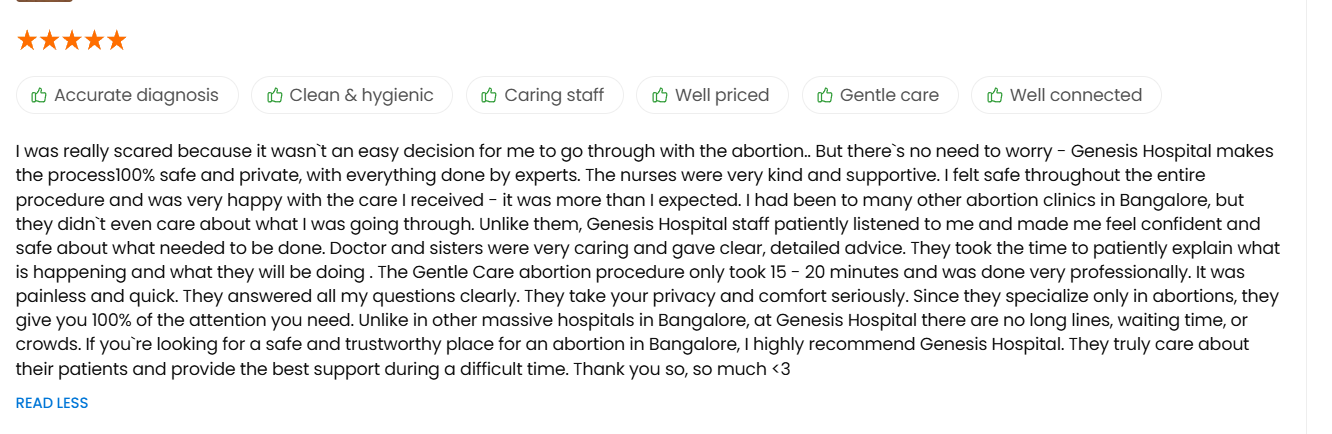
Here is how Bangalore Genesis Hospital elevates the clinical benchmark for a private, legally compliant abortion in Bangalore:
- Guaranteed Discretion and Confidentiality: We understand the deep anxieties associated with social stigma in India. Therefore, our hospital enforces strict privacy protocols. Your medical records and personal choices remain entirely between you and your trusted physician.
- Zero Crowded Waiting Areas: We value your comfort and peace of mind. By scheduling appointments strategically, we eliminate crowded public waiting rooms. Furthermore, you and your companion enjoy access to a completely private room, ensuring a peaceful, stress-free stay.
- MTP-Certified Clinical Excellence: As a fully approved Medical Termination of Pregnancy (MTP) facility, Bangalore Genesis Hospital follows rigorous international safety guidelines. Our senior gynaecologists perform highly advanced, pain-free techniques—such as gentle suction abortion—aligned with the World Health Organisation (WHO) recommendations.
- Efficient Same-Day Recovery: Most early-stage procedures take just 10 to 15 minutes to complete. Because we optimise our clinical workflows, you can comfortably return home to rest on the very same day.

Ultimately, a hormonal condition like PMOS should never compromise your mental peace, personal freedom, or future ambitions. You possess the power to shape your own life story. When you require expert clinical care, deep human empathy, and a highly secure environment, turn to Bangalore Genesis Hospital.
📞 Reach out to our specialised team today to book a completely private consultation and secure your health on your own terms.
Related Posts:
- Late Period? Understanding the ‘Why’ Behind & ‘What Next’?
- Can abortion cause infertility: What experts have to say?
- Motherhood Is a Choice: Respecting Every Woman’s Right to Choose
- Morning After Pill vs. Unwanted Kit: Knowing Your Timeline and Your Rights
- The ₹1.06 Lakh Protection: What Happens When Plan Goes Wrong
Quick Links:
- How Much Rest is Necessary After an Abortion?
- Reproductive Rights Shape Futures: Why Every Woman’s Choice Matters?
- How Soon Can You Resume Your Routine After an Abortion?
- 7 Things to Know Before You Buy an Unwanted Kit for Abortion
- What’s in a Name? Exploring Different Abortion Pill Names
