

Contents of This Post:
- Why Recovery Time After Abortion Matters: Every Woman’s Routine Looks Different
- How Abortion Method Influences Recovery: Pills vs. Suction vs. D&E
- How Soon Can You Get Back to Daily Activities at Home?
- Returning to Work: Guidance for Different Professions
- When Can You Resume Exercise, Travel, and Social Activities?
- Sexual Activity and Intimacy: When Is It Safe to Start Again?
- Emotional Recovery: Listening to Your Mind While Healing Your Body
- Choosing the Right Abortion Procedure in Bangalore
Making an abortion decision often brings up one very real and practical question: “How soon can I get back to my routine after abortion?”
Whether you are a student, a homemaker, a corporate professional, a chef, a teacher, or someone juggling multiple roles, your daily life has its own pace and responsibilities. You may worry about missing work, taking care of your family, managing classes, meeting deadlines, or meeting physical demands at your job. These concerns are valid, and they can even influence the choice of abortion method and even the timing.
The good news!
Most women recover quickly after an abortion—especially when they receive the right care and choose a method that aligns with their lifestyle. Science shows that the body bounces back well after a safe, medically supervised procedure. However, recovery still depends on the type of abortion, the physical nature of your routine, and how you support your body during the healing process.
This post walks you through everything you need to know—from when you can return to work or household chores to when you can resume sex, exercise, or travel. It also shows you how different abortion methods affect recovery, and why many working professionals prefer gentle suction abortion for a quicker and more predictable return to normal life. Weekend abortion services at Bangalore Genesis Hospital further make it easier to fit your abortion into your schedule without disrupting your week.
Let’s start by understanding why recovery varies from woman to woman.
Why Recovery Time Matters? Every Woman’s Routine Looks Different:
Your routine is unique, and so is your recovery. A woman who spends most of her day attending meetings or coding at a desk needs a different recovery plan than a chef who stands for hours or a teacher who moves constantly in the classroom. A homemaker may need to lift toddlers, manage cooking, or handle chores that require bending. A student may worry about attending long lectures or studying during recovery.
Each of these roles places different demands on your body—physically, emotionally, and mentally. That’s why your recovery should never feel like a “one-size-fits-all” answer.
What Science Says About Recovery?
Clinical research shows that after a safe, first-trimester abortion, most women return to light routine activities within the same day or the next day. Your uterus starts contracting back to its normal size immediately, your hormone levels begin settling, and your energy gradually returns.
However, your comfort level and the pace of your recovery still depend on:
- Firstly, the prescribed abortion method.
- Secondly, your overall health.
- Thirdly, your emotional readiness.
- Also, on how physically demanding your daily tasks are.
Why Your Lifestyle Matters?
A woman with a desk job can often return to work the next day after a suction procedure. On the other hand, a woman with a very active job—such as a nurse, factory worker, fitness trainer, or chef—may choose to take an extra day or two to feel fully comfortable.
Similarly:
- Unmarried students or professionals may need to plan around class schedules.
- Homemakers might need help with lifting or heavy chores for a day or two.
- Professionals with standing jobs may take slightly longer.
- Women with long commute hours, like cabin crew, may want a little more time before resuming travel.
Your daily rhythm shapes your healing experience, and knowing this upfront helps you plan better. Sleeping well is essential for healing well. So, women with night schedules or jobs that may involve jet lag may need to be attuned to their biological clock before resuming fully.
How Abortion Method Influences Recovery: Pills vs. Suction vs. D&E
Your post-abortion recovery depends greatly on the abortion method you choose or your abortion doctor prescribes, depending on your eligibility. For that, the doctor will first ascertain the pregnancy length and rule out ectopic pregnancy. Then, depending on your current medical situation and any history that may impact the procedure and recovery, your situation will be taken into account before finally prescribing you the best abortion method.
Each method affects how your body responds, how long your symptoms last, and how soon you can return to your routine. Understanding that, these differences help you make a decision that supports your health and your lifestyle.
Medical Abortion (Abortion Pills): Recovery Over Several Days
Abortion pills (Mifepristone + Misoprostol) work by inducing bleeding and cramping. Your body goes through a process similar to a heavy, crampy period—sometimes stronger. While this method is common, the recovery experience varies widely.
What You May Experience?
- Heavy bleeding for several hours.
- Moderate bleeding that continues for 7–10 days.
- Cramping, fatigue, mild fever, nausea, or loose stools.
- Emotional stress because you go through the process at home.
- Uncertainty about when exactly the abortion will be completed.
Some women recover smoothly. While others deal with prolonged bleeding or discomfort that affects work, house chores, college attendance, or physical jobs.
Risk of Extended Recovery:
Scientific data show that medical abortion carries a higher risk of incomplete abortion, especially as pregnancy advances beyond 7 weeks. If the abortion remains incomplete, bleeding continues, and you may need a suction or D&E procedure afterwards. That means:
- More time off.
- Double discomfort.
- A longer overall recovery.
Women with busy schedules, active professions, or limited sick leave often find this unpredictable recovery challenging.
Suction Abortion (Up to 12 Weeks): Quick, Predictable, and Clinic-Completed
A gentle suction procedure gives a very different recovery experience. The doctor completes the entire abortion in the clinic in a short visit. You walk out knowing the pregnancy has ended, and your recovery starts immediately.
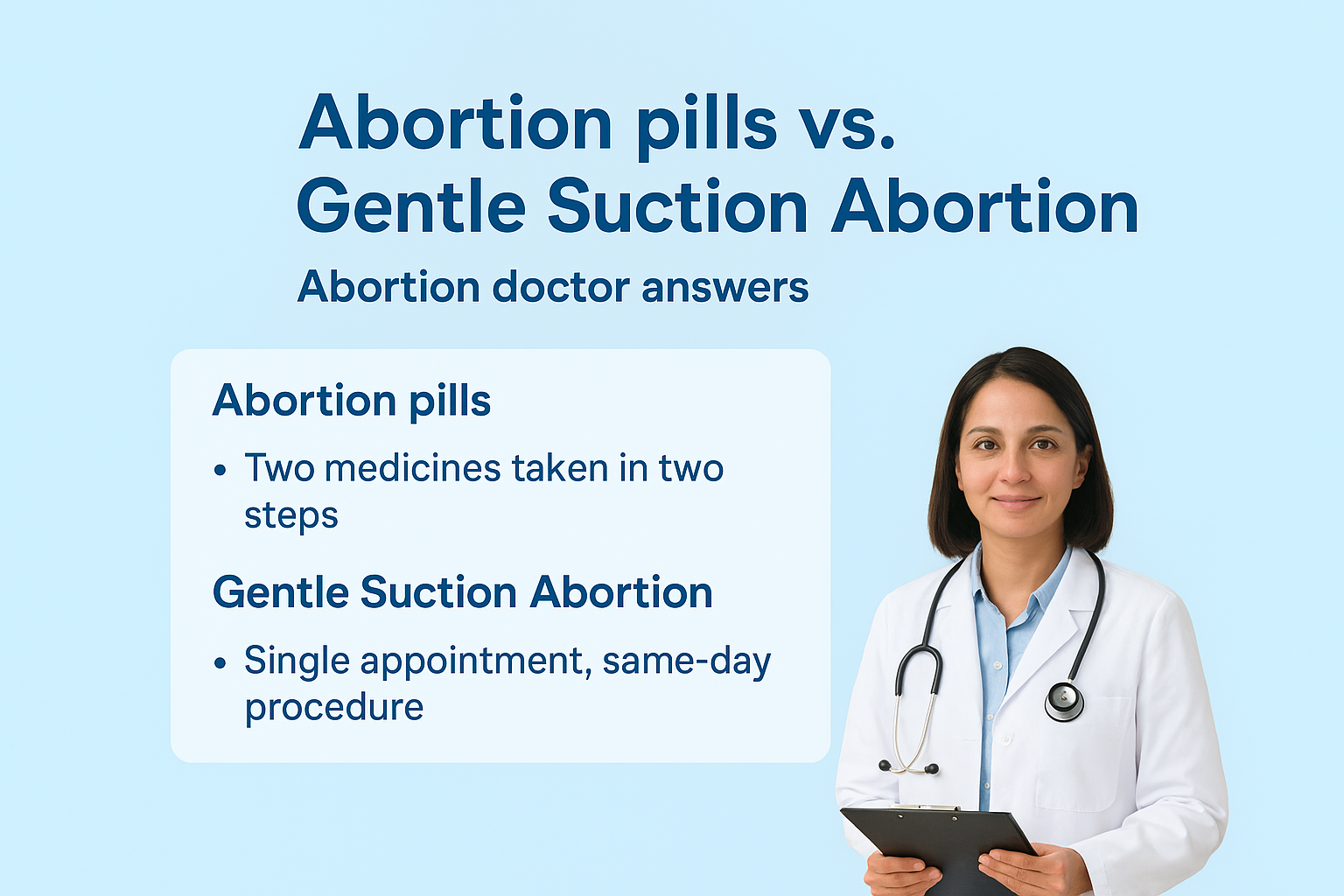
Why Recovery is Faster with In-Clinic Suction Abortion?
- The procedure takes just 3–5 minutes.
- You rest briefly in a recovery room.
- Most women feel well enough to go home soon after.
- Bleeding is usually light and lasts only a few days because the doctor will confirm the removal of pregnancy tissue within the clinic itself.
- You skip the emotional stress of waiting for pills to work.
Because the uterus empties during the procedure, your body does not go through days of cramping or prolonged bleeding. Many women return to desk jobs or light household work the next day. Some even resume normal activities the same evening with mild precautions.

Why Working Professionals Prefer Suction Abortion?
Women in IT, teaching, corporate roles, law, aviation, food service, or any demanding profession often choose suction because it:
- Minimizes downtime.
- Reduces pain.
- Avoids multiple days of abortion bleeding.
- It is more efficient with nearly zero probability of incomplete abortion requiring further treatment and procedure.
- Offers predictable recovery.
- Allows weekend scheduling at Bangalore Genesis Hospital.
This method supports women who cannot miss work, manage children alone, or keep bleeding for days.
D&E (Dilatation and Evacuation, 12–20 Weeks): Efficient but Needs a Little Extra Recovery Time
If the pregnancy is beyond 12 weeks, D&E becomes the safest and recommended procedure. It is still a highly efficient, medically supervised method.
What to Expect?
- The procedure is completed in the clinic, such as suction.
- You usually recover within a few days.
- You may feel mild cramping or tiredness for 1–2 days.
- Bleeding is usually light to moderate.
- You gain the assurance of a complete abortion without repeated attempts.
Although recovery takes slightly longer than suction, D&E still offers far more predictability and comfort than extended medical abortion bleeding at this stage.
How Your Abortion Method Shapes Your Routine?
- Medical abortion may stretch recovery over several days or weeks.
- Suction abortion allows most women to resume their routine quickly—even the next day.
- D&E offers a reliable and complete procedure with a moderate recovery time.
Knowing these differences helps you plan your schedule, choose the right method, and feel confident about your return to normal life.
How Soon Can You Get Back to Daily Activities at Home?
Home routines look different for every woman. Some manage cooking for the entire family, others care for toddlers or elderly parents, and some juggle household chores with online classes or remote work. Naturally, you may wonder how soon you can return to these responsibilities after an abortion.
Your recovery—and how quickly you resume home activities—depends on the abortion method and how physically demanding your daily tasks are.
After a Suction Abortion:
Most women feel ready to go back to light home activities on the same day or the next morning. Because the procedure completes in the clinic and bleeding stays light, you regain comfort and control much faster.
You Can Usually Resume Soon:
- Light cooking
- Basic cleaning
- Taking care of school-aged children
- Working on your laptop
- Walking around the house
- Light errands
You may still choose to take things easy for a few hours, but your body often feels steady and manageable very quickly.
What to Postpone?
- Heavy lifting (like buckets of water, gas cylinders, or lifting toddlers)
- Continuous bending
- Deep cleaning or mopping
- Strenuous physical chores
Give your body 24–48 hours before returning to more demanding tasks.
After Medical Abortion (Pills):
Recovery at home feels different because your body goes through several hours of heavy bleeding and strong cramps. You may not feel ready to manage even simple chores on the same day.
Expect Needing More Time For:
- Resting on the first day of bleeding.
- Managing unpredictable bleeding.
- Taking breaks between activities.
- Dealing with cramps or tiredness.
- Handling nausea or loose stools (common with Misoprostol).
Most women resume light chores in 2–3 days, but strenuous tasks may still need postponing.
If bleeding continues for a week or more, your routine may feel disrupted until the process completes.
After a D&E (13–20 Weeks):
D&E requires a little more recovery time simply because the pregnancy is more advanced and your body needs a short window to settle.
You Can Usually Resume:
- Light chores the next day.
- Normal movement around the house.
- Simple cooking.
You Should Wait a Little Before:
- Lifting weight
- Managing toddlers alone
- Doing physically demanding tasks
Give yourself 2–3 days before you return to heavier responsibilities.
Listen to Your Body
While guidelines give you a general timeline, your body’s signals matter the most. Some women may get better quicker, while others may need more time to settle in, regardless of the abortion method. Besides, some women experience unexpected emotional mix with relief, guilt or grief and sometimes just not knowing if what they chose was the right decision. These feelings may not show up like physical weariness, but they definitely impact one’s getting back to normalcy.
So, regardless of your abortion method, stop and rest if you feel:
- Increasing pain
- Giddiness
- Excess fatigue
- Cramping after exertion
This is your body’s way of asking for gentler care.
Why Home Routines Are Easier After Suction?
Many women choose suction because recovery starts immediately. You don’t spend days waiting for bleeding to stop or worrying about an incomplete abortion. You regain your energy sooner, manage your home with confidence, and return to your normal roles without prolonged discomfort.
Returning to Work After Abortion: Guidance for Different Professions
Going back to work after an abortion can feel like a big decision, especially when every job demands something different from your body and mind. You may worry about long hours, physical strain, standing for extended periods, or simply staying focused during meetings or classes. Your concerns are completely valid, and understanding how your work environment interacts with your recovery can help you prepare with confidence.
Furthermore, your abortion method also plays a major role here. Suction abortion generally allows women to return to work sooner because the procedure completes in one visit, bleeding stays lighter, and discomfort resolves quickly. Medical abortion, on the other hand, may create unpredictable symptoms for several days, which can interfere with work responsibilities.
Let’s look at how different professions may approach recovery.
Office Jobs, IT, Teaching, Law, and Similar Roles:
If your work mostly involves sitting, writing, taking calls, attending meetings, or teaching in a classroom, you will likely recover quickly—especially after a suction procedure. Many women return to such roles the very next day, and some feel comfortable enough even on the same day after a few hours of rest.
With suction abortion,
- You may feel mild cramping or light spotting, but both are manageable.
- Also, you can sit comfortably for long hours.
- Then, you can concentrate without the distraction of heavy bleeding or pain.
- Women often describe feeling relieved because they can maintain their professional responsibilities without prolonged downtime.
With medical abortion,
Returning to office or teaching duties may feel more challenging because:
- Bleeding can remain heavy or unpredictable for several days.
- You may feel tired, emotional, or physically drained.
- Strong cramps may interrupt meetings, classes, or long working sessions.
Most women prefer taking 4–5 days off if using pills.
Jobs That Require Standing, Walking, or Moderate Physical Work:
Professions such as hospitality, retail, nursing, kitchen staff, cabin crew, salon professionals, or teachers who move frequently through classrooms place more physical demands on your body.
After a suction abortion, many women resume these roles comfortably in 1–2 days. You may simply need to avoid:
- Frequent bending
- Lifting heavy boxes
- Continuous, fast-paced walking
Your energy returns quickly, but giving yourself a short buffer helps your body feel stable and supported.
After a medical abortion, recovery may feel slower because:
- Bleeding can worsen with movement.
- Fatigue sets in more easily.
- Cramps may intensify when you remain on your feet.
Women with physically mobile jobs often prefer suction specifically to avoid these interruptions.
High-Intensity or Physical Labour Jobs:
Chefs, factory workers, warehouse staff, fitness trainers, domestic workers, delivery staff, and women who lift heavy objects regularly need to give special attention to their recovery.
After suction abortion:
- Most women can return in 2–3 days, depending on how strenuous their job is.
- The body feels steadier compared to medical abortion because bleeding is lighter.
- You avoid sudden pain episodes that commonly follow Misoprostol-induced contractions.
After medical abortion:
- Heavy labour becomes difficult due to cramping and fluctuating bleeding.
- Many women feel weak or lightheaded due to the intensity of the bleeding phase.
- Returning too early may increase discomfort or the risk of prolonged bleeding.
- These women often find suction abortion more practical, predictable, and empowering for managing work commitments.
Students and Women Preparing for Exams:
Students often juggle classes, long lectures, study sessions, internships, travel between campus locations, and exam preparation. Many of them also live in shared spaces where privacy is limited.
Suction abortion works especially well for students because:
- The process finishes in a single clinic visit.
- Recovery is quick, allowing them to return to classes the next day.
- They don’t experience days of heavy bleeding that disrupt study plans.
- There’s no anxiety about managing an incomplete abortion during crucial academic days.
- Students often benefit from scheduling the procedure on a Saturday, using the weekend to rest, and returning fresh on Monday.
Homemakers, Mothers, and Women Managing Household Responsibilities:
Homemakers often underestimate how physically demanding their work is—cooking, lifting children, sweeping, groceries, laundry, and constant movement through the day. This lifestyle also requires quick recovery because the home depends on them.
After suction abortion:
- Many return to routines the same day or the next day.
- They can comfortably manage cooking, basic cleaning, and caring for older children.
- They may still postpone heavy lifting or deep cleaning for 24–48 hours.
After medical abortion:
- Prolonged bleeding and cramps may make chores difficult.
- Caring for small children becomes very hard when dealing with pain or fatigue.
- Household workload may pile up unless they have support.
Many mothers prefer suction because it gives them more control over their day-to-day responsibilities.
Why Working Professionals Often Choose Suction Abortion?
Across professions—whether corporate, creative, academic, service-oriented, or physically intensive—women appreciate how suction abortion:
- Minimizes disruption
- Provides predictable recovery
- Reduces bleeding to a shorter duration
- Eliminates the uncertainty of pills
- Allows smooth return to routine
- Fits into their schedule without anxiety
This is also why Bangalore Genesis Hospital offers weekend abortion services, giving working women the freedom to undergo a safe procedure on Saturday and resume normal activities on Monday—without the need to take sick leave or explain absences.
When Can You Resume Exercise, Travel, and Social Activities?
Life doesn’t pause for long, and you may wonder when you can safely get back to your fitness routine, step out with friends, or travel for work or personal commitments. Your recovery timeline depends on your abortion method and how your body responds, but most women resume these activities sooner than they expect—especially after a suction procedure.
Let’s break it down in a practical, lifestyle-focused way.
Exercise and Fitness Activities
Your fitness routine may range from light stretching to high-intensity workouts. Each activity places a different level of strain on your abdominal muscles and pelvic region, so returning gradually protects your healing uterus and helps prevent discomfort or bleeding.
After Suction Abortion:
Most women get back to gentle physical activity within 1–2 days because the uterus empties completely during the procedure, and cramping subsides quickly.
You can usually resume:
- Light walking the same day or the next day.
- Stretching and deep breathing exercises every 24 hours.
- Mild yoga (avoiding inversions) in 2–3 days.
You may want to wait about a week before returning to:
- Intense cardio
- Weight training
- High-impact workouts
- Abdominal workouts
- Running or skipping
Your body will guide you. If you feel a tugging sensation, pelvic pressure, or renewed bleeding, pause and give yourself a little more time.
After Medical Abortion (Pills):
Because bleeding remains heavier and more unpredictable with pills, your return to exercise may take longer.
Many women prefer waiting at least:
- 3–5 days before light exercise
- 7–10 days before moderate intensity
You may find that cramping increases during activity, so gradual progression makes recovery smoother.
After D&E:
Women usually appreciate getting back to gentle activity after 2–3 days.
For stronger workouts, waiting around a week is ideal.
Travel After an Abortion:
Travel plans—whether for work, family commitments, or personal reasons—often worry women because travel involves prolonged sitting, unpredictable access to restrooms, and limited privacy if bleeding increases.
After Suction Abortion:
Many women travel comfortably in 1–2 days, sometimes even the same day if it’s short-distance. This becomes possible because:
- Bleeding remains light.
- Cramping is minimal.
- You don’t face uncertainty about whether the abortion is complete.
Women who need to travel frequently for corporate jobs, client meetings, or outstation work trips often choose suction for this reason.
After Medical Abortion:
Travelling soon after pills can feel difficult due to:
- Heavy and unpredictable bleeding
- Painful cramps
- Possible nausea or diarrhoea
- Passage of clots while on the move
Most doctors advise avoiding travel for at least 3–4 days, and sometimes longer if bleeding remains intense. If your job involves frequent field visits, flights, or long commutes, planning becomes particularly important.
After D&E:
Most women feel travel-ready in 2–3 days, but long-distance travel may require waiting slightly longer until your energy levels return fully.
Social Activities: Outings, Events, and Gatherings
Social activities often require emotional readiness as much as physical comfort. You may want to step out for a meal, meet friends, attend a class, or take your children to the park. These activities usually feel achievable sooner than women expect.
After Suction Abortion:
You can usually resume light social outings the same day or the next day.
Many women feel stable, confident, and comfortable enough to:
- Go for a relaxed coffee
- Attend a family dinner
- Visit a friend
- Pick the children up from school
Just remember to avoid strenuous activity or long walking on the first day.
After Medical Abortion:
Because bleeding and cramps can start suddenly with Misoprostol, most women prefer resting at home for the first 24–48 hours. Socialising becomes more comfortable after bleeding becomes lighter.
After D&E:
A short walk outside or meeting a friend becomes possible after 1–2 days, depending on your comfort.
Why Suction Abortion Supports an Active Lifestyle Better?
For women with fitness routines, travel schedules, or active social lives, suction abortion often feels like the most practical option because:
- Recovery starts immediately.
- Symptoms clear faster.
- Activity restrictions shorten.
- Unpredictable bleeding does not interfere with plans.
- The procedure fits easily into a weekend.
This predictability allows women to maintain their lifestyle with minimal disruption and greater peace of mind.
Sexual Activity and Intimacy: When Is It Safe to Start Again?
Questions about sex after an abortion are extremely common, yet many women hesitate to ask them openly. You may wonder when your body becomes ready again, whether sex will feel different, or if you need to take extra precautions to protect yourself. Intimacy involves both physical comfort and emotional readiness, so your concerns matter.
Let’s walk through what you can expect and how your abortion method influences your timeline.
Why You Should Wait Before Having Sex?
After any abortion—medical, suction, or D&E—the cervix remains slightly open for a short period. This natural preparation for miscarriage or evacuation makes your body more vulnerable to infection immediately afterwards.
To protect your reproductive health, most doctors recommend avoiding vaginal intercourse for at least 1 week, sometimes up to 2 weeks if you have:
- Heavier bleeding
- A medical abortion
- A second-trimester D&E
- A more sensitive recovery phase
Your uterus needs this brief window to heal comfortably, and giving it that time prevents unnecessary complications.
After a Suction Abortion:
Women generally feel physically ready for intimacy sooner after suction because:
- The procedure is completed in the clinic.
- Bleeding reduces quickly.
- Cramping settles within hours.
- You regain a sense of bodily comfort and stability.
Many women resume sexual activity after 7–10 days, provided they feel emotionally ready and their bleeding has either stopped or become very minimal.
You may still choose to take it slow initially. Gentle intimacy, open communication with your partner, and listening to your body create a comfortable transition.
After Medical Abortion (Pills):
Recovery after pills takes longer due to ongoing bleeding, cramping, and hormonal shifts. Because the bleeding phase continues for several days, your body needs more time before you feel comfortable with any form of vaginal activity.
Most women prefer waiting 10–14 days, and sometimes a bit longer if:
- Bleeding remains moderate.
- They feel fatigued.
- The process took several days to complete.
- They experienced significant discomfort during the abortion.
It’s important not to rush intimacy. Your comfort matters more than any timeline.
After D&E (12–20 Weeks):
Your body goes through deeper changes during a second-trimester procedure, so recovery takes a little longer. Many women comfortably wait 10–14 days before resuming sexual activity.
Light spotting may continue for a short period, and it’s better to wait until it settles.
Remember, tenderness or emotional sensitivity is normal after a later abortion. Give yourself space and kindness during this time.
Emotional Readiness: Your Heart Matters as Much as Your Body
Sexual activity is not only a physical act—it’s deeply influenced by emotions. You may feel:
- Relieved
- Sensitive
- Disconnected
- Needing comfort
- Wanting closeness
- Or needing space
All of these feelings are completely normal.
Take your time. Speak openly with your partner. Approach intimacy gently. There is no “right” time; there is only your time.
Fertility Returns Quickly—So Consider Contraception
One important fact many women don’t realise:
You can get pregnant again within 2–3 weeks after an abortion, even before your next period.
If you don’t want a pregnancy right away, start contraception as soon as your doctor recommends it. Suction abortion often allows you to start contraception immediately, while after the pills, you may start soon after the abortion is completed. At Bangalore Genesis Hospital, many women also opt for IUCD (Copper-T) insertion just after the abortion at the same appointment. This gives them freedom from worrying about future unplanned pregnancies and abortions.
Additionally, your doctor can help you choose what suits your lifestyle—pills, condoms, IUDs, injectables, or long-acting methods.
Why Suction Abortion Creates a Smoother Return to Intimacy?
Women recovering from suction abortion often regain physical comfort and emotional ease faster because the process is quick, predictable, and clinic-completed. There’s no prolonged bleeding or uncertainty, which means you can reconnect with your body and your partner sooner, without stress.
Emotional Wellness During and After the Procedure:
Along with physical care, your emotional well-being matters just as much. Many women feel a mix of relief, uncertainty, guilt, or anxiety during this period, and all these feelings are completely normal. When you choose a trusted abortion clinic in Bangalore, the doctor guides you with calm, compassionate counselling so you don’t feel alone at any stage.
Give yourself time to process your emotions. Talk to someone you trust, rest well, and avoid judging yourself for your feelings. If you prefer professional support, most clinics can connect you with counsellors who help you cope and heal. Prioritising emotional wellness helps you recover faster and move forward with clarity and strength.
Choosing the Right Abortion Procedure in Bangalore:
Choosing the right method for abortion in Bangalore depends on your pregnancy length, health needs, comfort level, and personal preferences. When you walk into a reputable abortion clinic in Bangalore, the doctor first reviews your medical history and performs an ultrasound. This helps you understand how far along you are and which procedure will work best for you.
If your pregnancy is within 6–8 weeks and you feel comfortable with a pill-based process, the doctor may guide you with a medical abortion. You learn exactly what to expect—cramping, bleeding patterns, when to seek help, and how to monitor the progress safely at home.
If you prefer a quicker, clinic-based procedure and the pregnancy is within the first 12 weeks, the doctor may recommend a suction abortion. You stay in the clinic for a short time, and the team keeps you comfortable throughout. The recovery is usually fast, and many patients feel relieved because the process offers clarity and completion within minutes.
For pregnancies between 13 and 20 weeks, D&E becomes the safest and most reliable option. The doctor ensures you stay informed at each step and receive the emotional and physical support you need. Women often say they feel reassured when the doctor explains the process in detail and stays available for follow-up care.
No matter which option you consider, a licensed and experienced gynaecologist helps you choose the safest path so you can move forward with confidence.
Safe abortion in Bangalore
gives you choice, privacy, and support at every stage. Whether you are exploring medical abortion, suction abortion, or a D&E procedure, you’ll find experienced doctors and well-equipped clinics ready to guide you. When you receive proper counselling and clear information, the confusion and fear reduce significantly. You regain control over your health and make decisions that align with your comfort and plans.
Ending a pregnancy is a sensitive moment, and you deserve care that respects your dignity and well-being. With the right medical team, the journey becomes safer, smoother, and emotionally easier.
Schedule a gentle abortion in Bangalore appointment.
Related Posts:
- How to Take Care of Yourself After an Abortion?
- 7 Things to Know Before You Buy an Unwanted Kit for Abortion
- What Guides Safe Abortion? Parameters Defining Abortion Care
- What’s in a Name? Exploring Different Abortion Pill Names
- “Is Same-Day Abortion Possible Without Hospital Stay?”
Quick Links:
- Understanding What Your Menstrual Cycle Speaks & When it Seeks Attention
- Can Pineapple Cause Abortion? How much Pineapple to Eat in Pregnancy?
- Can Abortion Cause Endometriosis? Facts& Risks; Why Safe Abortion Matters?
- Abortion and Relationships: How to Discuss Your Decision with Partners, Family, and Friends?
- Can Abortion Cause Adenomyosis? Truth Between the Lines
- Hire a cab for abortion in Bangalore
