
After Your Abortion: Your Personal Guide to Rest and Recovery (No One-Size-Fits-All Answers Here!)
Contents of This Post:
- The Abortion Method Matters – Medical Abortion vs. Surgical Abortion
- Your Work Life & Your Post-Abortion Recovery Clock
- It’s Personal – Your Health, Your Body’s Timeline
- Did You Think About the Weather? Seriously!
- Bringing It All Together – Your Personal Recovery Plan
Let’s Talk Real Recovery
Hey there. If you’re reading this, you’re probably riding a Columbus of fair, navigating fear, anxiety and are in a midway of deciding while dealing with a lot of stress hormone. Besides, every option bring in more questions and multiplying your stress while already dealing with an unwanted pregnancy or coming out of abortion phase (can be for planned or an unplanned pregnancy). Now, one of the most practical and pressing question you might be thinking of can be: “How much downtime do I really need after the abortion?”
Maybe you’re a student worrying about missing lectures, a project manager with deadlines looming, a teacher with a classroom that can’t run without you, or a homemaker who keeps the whole ship afloat. Your life doesn’t hit pause, even when your body needs you to. Whether you recently had an abortion or you are planning to obtain one but are worried about how much recovery time you may need after the procedure, this post is for you.
So let’s clear something up from the start: there is no universal rule. The classic “take it easy for a few days” advice can feel frustratingly vague. What does “easy” mean when your normal day involves chasing toddlers, presenting to clients, coding for hours, or standing in a lab or classroom?
This guide isn’t about a rigid timeline. Rather, it’s about creating your personal recovery blueprint. We’ll look at how your unique work demands, the type of procedure you had, your own health, and even, surprisingly, the weather outside your window, all shape your need for rest.
Your body has been through something significant, and honouring its need to heal isn’t a luxury—it’s a crucial part of your well-being. And doing it right means you can return to your life stronger and sooner.
How The Abortion Method Shapes Your Recovery?
Let’s get one thing clear: the single biggest factor that determines your recovery timeline isn’t your job—it’s how far along you are. This fact is crucial for planning, whether you’re a student eyeing your exam calendar, a lawyer prepping for a case, or a professional managing a project deadline.
The principle is straightforward: An earlier procedure generally means a physically simpler process and a quicker return to normal activities. This isn’t just about convenience; it’s a key medical and legal reality that can empower your planning.
Understanding Your Legal and Medical Window for Abortion in India:
In India, the law provides a clear framework. Under the Medical Termination of Pregnancy (MTP) Act, any woman—married or unmarried—can seek an abortion up to 20 weeks of gestation based on a broad range of conditions like contraceptive failure or others affecting her physical or mental health. In specific cases (like survivors of sexual assault or minors), this limit extends to 24 weeks.
Why is this window important for planning? Because the methods used, and thus the recovery, change as pregnancy progresses.
- Firstly, up to 12 weeks: You have more options, including medical abortion (the abortion pill) or a quick in-clinic procedure like vacuum aspiration (suction abortion). The abortion pill or the medical method of abortion works best only in early pregnancies up to 6 weeks, and not to forget that they work only for intrauterine pregnancies. Ectopic pregnancies are differently treated, as abortion pills like Unwanted Kit or any other MTP kit do not work on them.
- Secondly, Between 13-20 weeks: Now, the procedure becomes more involved, typically requiring a surgical method known as Dilation and Evacuation (D&E), which is more complex and demands more planning for rest.

The key takeaway for planning: While life gets busy, it is critically important not to delay beyond the legal and safe gestational limits due to exams or work. Pushing a procedure into a later gestational bracket out of scheduling concern can inadvertently lead to a more complex recovery, requiring more time off, not less.
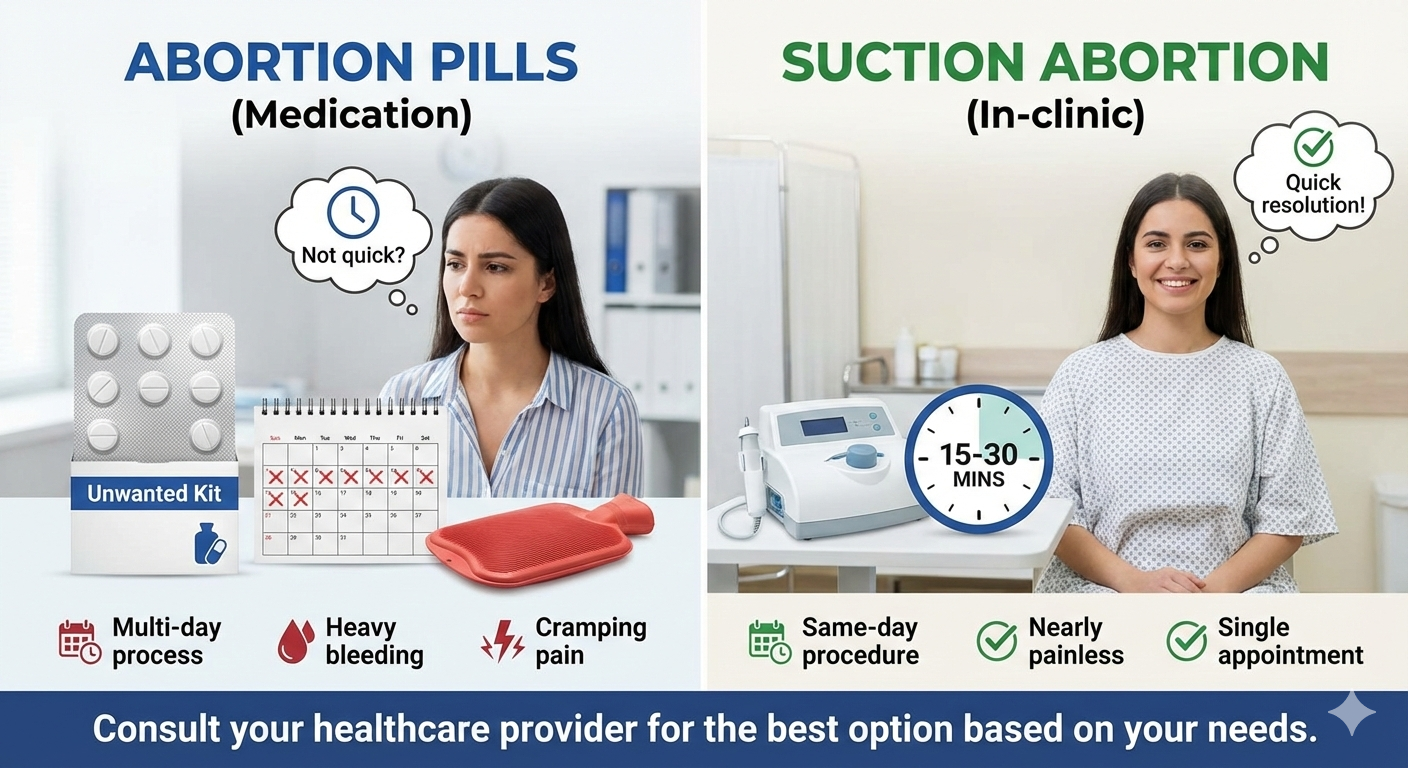
How Abortion Methods Compare: From a Few Days to a Planned Break
Here’s a breakdown of what to expect from different abortion methods and how they might fit into your schedule:
| Gestational Age | Typical Method | What to Expect & Physical Demand | Typical “Down Time” & Planning Notes |
| Up to 12 weeks | Medical Abortion (The Pill) | Process occurs at home. Involves strong, cramp-like pains and heavy bleeding for several hours as the pregnancy passes, similar to a very heavy period. | Plan for 1-2 days completely off. You need to be in a comfortable, private space to manage the intense phase. You can likely return to sedentary work/online lectures within 2-3 days.
|
| Up to 12 weeks | Vacuum Aspiration (Suction Abortion) | A 5-10 minute in-clinic procedure, often with local anaesthesia. You may feel cramping. You’ll rest at the clinic for 30-60 minutes after. Same day discharge. Abortion completes in the clinic itself. | Plan for overnight rest. Many feel well enough for light activity the next day. Mild cramping and spotting may continue if you are close to 12 weeks, so a quiet day or two is ideal.
|
| 13-20 weeks (Second Trimester Abortion) | Surgical Abortion (D&E) | A more involved process. It often requires a two-day clinic visit: Day 1 for preparation, Day 2 for the procedure. You will be under deeper sedation or anaesthesia. But at Bangalore Genesis Hospital, D&E is completed on a single appointment if multiple visits is not possible for you. | Plan for 3-4 days of rest. While you may feel okay to move around after a day, your body has been through a more significant process. More rest aids healing and prevents complications.
|
Scheduling Smart: A Guide for the Time-Pressed
Knowing this, how do you plan? Let’s translate this into real-life scenarios:
For the Student with Exams Sooner: If you discover your pregnancy early, you might schedule a suction abortion for the start of a weekend. This gives you 2-3 days to physically recover during a time you wouldn’t be in class anyway. Don’t cancel an appointment this week for an exam not within a week; the latter procedure will require more recovery time, potentially disrupting your study schedule more severely.
For the Lawyer or Corporate Official: For an early procedure, you could schedule it for a Thursday. Then, you can take Friday off, giving yourself a 3-day weekend (Friday, Saturday, Sunday) to rest. So, you can likely return to desk work and mental tasks on Monday. However, for a later-term procedure requiring a D&E, you will need to block your calendar for the two clinic days plus at least 3-5 recovery days. This is a non-negotiable medical appointment that requires advanced planning, as you would for any minor surgery.
For the Homemaker or Anyone with Inflexible Duties: This is where calling in your support system is essential. For any procedure, but especially later ones, arrange help for 2-5 days. This means having someone handle childcare, cooking, and heavy chores. Your job is to rest, not to run the household.
Listen to Your Body and Your Doctor
These timelines are guides. But your doctor will give you personalised advice, and your body will give you clear signals. So, pushing yourself to return to a high-stress job or physical labour too quickly can lead to prolonged bleeding or pain.
Your Work Life & Your Post-Abortion Recovery Clock
Now, let’s get straight to the heart of your daily reality. Your job—whether it’s paid, unpaid, at an office, or at home—directly shapes what “rest” needs to look like. Recovery isn’t about doing nothing; it’s about strategically pausing the activities that demand the most from you. So, let’s break it down by the kind of energy your work drains.
For the Crew Always On Feet (Homemakers, Healthcare Workers, Cabin Crew, Engineers Teachers, Retail/F&B Staff)
Your step counter on that smart watch you are wearing doesn’t lie. We know, your normal day is a marathon of lifting, bending, standing, and moving. After an abortion, your body is directing energy inward to heal, which can leave you with significantly less stamina.
The Homemaker’s Hustle: We see you. We know you. More that that, we understand your job and how much energy draining it is. The laundry, the cooking, the cleaning, the errands—it’s a 24/7 operation with no sick leave. “Rest” here means delegating the heavy lifting (literally). So, for 3-5 days, can someone else handle the grocery bags, the mopping, or the toddler-chasing? Your goal is to trade roles: you become the supervisor, not the primary labourer. A week of simpler meals (think one-pot wonders or approved help) is not just okay, it’s necessary.
The Frontline Professionals (Nurses, Teachers, Retail): You can’t just “sit at your desk.” If you can, aim for at least 2-3 full days completely off your feet, followed by a week of modified duty if possible. Talk to your administrator about light duty—perhaps administrative tasks instead of hallway patrol, or seated activities in the classroom. Besides, listen to your body; if you’re on a shift and feel dizzy or cramping intensely, that’s your cue to sit down immediately. Additionally, proper hydration and supportive shoes are non-negotiable during this time.
For the Women Warriors With 24 x 7 Wired Mind (IT Professionals, Lawyers, Corporate Officials, Students)
Although your work might look physically easy, but the mental and emotional load is a heavyweight champion. Stress, concentration, and continuous cognitive processing are massive energy consumers that can delay physical healing.
The Corporate & Tech Grind: Your brain is occupied juggling projects, emails, glitches, technical advancements and deadlines. But true rest means a digital detox and a hard stop on multitasking. So, a 2-3 day complete break from work emails and slack is ideal. If you must log on, batch tasks into short, focused 90-minute blocks followed by real breaks—lying down with your eyes closed, not scrolling social media. The mental fatigue you feel is real; it’s your body asking you to power down the mainframe so it can run its essential healing programs.
The Student’s Sprint: Exam pressure doesn’t care about your personal life. But pushing through with all-nighters will backfire. Plan for a 48-72-hour academic pause. Notify professors or advisors (you don’t need to tell them details, just “a medical procedure”). Use this time for genuine rest, not guilt-ridden “I should be studying” anxiety or even the guilt. After that, study in shorter, more frequent sessions. Your ability to retain information will be better if your brain isn’t also fighting a resource war with your healing body.
For the Sedentary but Super-Stressed (Administrative Roles, WFH Professionals)
Sitting all day might seem like the ideal recovery position, but it comes with its own traps. Prolonged sitting can increase pelvic discomfort and the risk of blood clots. Plus, the blurry line between home and work when WFH (Work From Home) makes “logging off” incredibly hard.
The Desk-Bound Dilemma: Your challenge is movement, not exertion. So, set a timer to get up and gently walk for 5 minutes every hour. This boosts circulation and aids healing. Invest in a truly comfortable chair or use supportive pillows. But crucially, your rest also involves creating a firm end to your workday. So, when it’s time, shut the laptop, leave the home “office” corner, and change your environment. Just because you’re physically home doesn’t mean you’re “resting” if your mind is still at work.
The Common Thread? Communication.
No matter your field, if you have the option to tell someone, a simple, “I’m having a minor medical procedure and will need a few days of light duty,” can grant you the space you need. Your productivity this week does not decide your worth. Giving your body the right type of rest for your specific work life is the smartest, most efficient way to get you back to your full, powerful self.
Of course, if you do not wish to tell anyone about the medical procedure, you do not have to mention abortion. You can just mention that you are not feeling well and need some time for rest. This stays true for every woman, married or unmarried, homemaker, project leader, businesswoman, student, professional, lawyer, teacher, or anyone and everyone.
It’s Personal – Your Body’s Unique Blueprint for Healing
We’ve talked about your work and the procedure. Now, let’s talk about the most important variable in this entire equation: you. No two recoveries are identical, not even for the same woman. Your personal health history and current well-being are the lead directors of your healing timeline. Understanding this can relieve the pressure to compare your journey to anyone else’s.
Your Physical Health: How Your Health is The Foundation
Think of your body’s resilience like a battery. How charged were you going into this? Several key factors determine your capacity to recharge.
Firstly, Gestational Age & Abortion Method: This is the single biggest physical factor, as we discussed. An early, straightforward procedure asks less of your body’s resources than a later, more complex one. So, healing from a process at 8 weeks is inherently different from one at 18 weeks.
Secondly, Your Baseline Fitness & Strength: This isn’t about being an athlete. Rather, it’s about your body’s reserves. So, if you were generally active and well-nourished beforehand, you may find your stamina returns a bit quicker. However, this is not a cue to “push through.” Even the fittest bodies need dedicated healing time.
Thirdly, Pre-existing Conditions: Conditions like anaemia (low iron), endometriosis, adenomyosis or thyroid disorders can influence recovery. For instance, anaemia might make you feel fatigued for longer. Hence, it’s crucial to share your full health history with your provider so they can give you tailored advice.
Finally, How Your Body Responds: Some people experience minimal cramping, while others have more. Then, bleeding patterns vary. So, your experience is normal. Now, the red flags to watch for (like fever, severe pain, or soaking through two pads per hour for two hours) are universal, but the general course of healing is personal.
Your Emotional & Mental Landscape: The Invisible Healing
Firstly, We cannot overstate this: Emotional recovery is valid, real, and often operates on a different clock than physical healing. Your mind and heart not only deserve but they also need rest.
Secondly, the Spectrum of Feelings: You might feel relief, sadness, numbness, grief, or a complex mix that changes by the hour. All of it is normal. A 2021 study in Social Science & Medicine found that while most women do not experience long-term negative mental health outcomes, the immediate days and weeks can be emotionally intense as hormone levels level out.
Thirdly, Stress is a Physical Burden: So, if you were under significant stress before or after the procedure—whether from the decision itself, work pressure, or a lack of support—your body is dealing with that too. Chronic stress floods your system with cortisol, a hormone that can actually slow down physical repair and zap your energy.
Finally, Your Support System: Do you have someone to drive you home, make you a cup of tea, or simply sit with you? Practical and emotional support dramatically impacts your ability to rest deeply. Doing this alone requires you to be your own caregiver, which is an extra layer of mental work. But that is possible too. If you want to know how, we will write a dedicated post addressing your concern. Just leave a comment if you want it.
So, how do you sync with your body’s blueprint?
- Firstly Consult, Then Customize: Use the 1-7 day guidelines from your doctor as a framework, not a strict rule. If they say “2-3 days of rest,” but on day 4, you are utterly exhausted after a simple work call, your body is saying it needs more. Honour that.
- Secondly, Check in with Yourself: Morning and night, ask: “What do I need today?” Is it an extra hour of sleep? Or should I consider a warm shower? Or a quiet walk? A good cry? Permitting yourself to meet that need is active recovery.
- Then, Prioritise Emotional First Aid: If you have access to counselling or a trusted support line, use it. For many, journaling or gentle creative expression can help process feelings. Your goal is not to “get over it” but to move through it with kindness. So, recognise it to give it a fine closure. When you finally embrace it, then only can you move ahead with confidence and clarity about what you need in future.
As per the old wise sayings,
जो हुआ, अच्छा हुआ, जो होगा, वो भी अच्छा ही होगा; जो होता है, उसमें कुछ ना कुछ भलाई छुपी होती है |
You, too, may get past it and embrace sunshine after the night ends.
If the emotional reality of postpartum depression is widely acknowledged, the complex mix of feelings after an abortion is just as valid, yet often spoken of in whispers. Prominent figures like Deepika Padukone and Anushka Sharma have powerfully normalised conversations about clinical depression and anxiety, while others like Sameera Reddy and Ileana D’Cruz have shared their vulnerable journeys through postpartum depression. Their public strength makes a crucial point: facing an emotional challenge does not diminish your resilience—it defines it.
In the same way, the hormonal shift and personal significance of an abortion can bring a surge of emotions, from relief to sadness, or a confusing blend of both. This is a normal part of your body’s and mind’s processing. Being strong doesn’t mean being immune to these feelings; it means recognising when you need to tend to your emotional recovery with the same care as your physical healing.
So, your recovery is a holistic process. Hence, giving attention to both the physical and emotional signals is how you heal wholly and effectively.
Next, we’ll tackle a factor you might not have considered—how the very weather outside your window can play a role in your comfort and post-abortion recovery.
Did You Think About the Weather? Your Climate’s Role in Post-Abortion Recovery
Believe it or not, the forecast matters. Just as you’d dress differently for a monsoon than a summer heatwave, your recovery strategy can benefit from a little weather adjustment. Your environment plays a subtle but real role in your comfort and healing pace.
Navigating Hot & Humid Climates (Hello, Bangalore Summers and Tropical Regions)
Heat and humidity can amplify the natural fatigue that comes with recovery and present specific challenges.
- The Fatigue Factor: Firstly, your body is already working hard to heal. Now, add in the energy it expends trying to keep cool, and you can feel disproportionately drained. Listen to this signal—it means you need more rest in a cool, comfortable environment, not more caffeine.
- Hydration is Your #1 Job: Secondly, bleeding (even normal spotting) combined with sweating increases your risk of dehydration, which can cause dizziness and worse cramps. So, make water, electrolytes (from coconut water or oral rehydration solutions), and watery fruits your constant companions.
- Preventing Discomfort & Infection: Now, this is crucial. So, change pads frequently—more often than you might in cooler weather—to stay dry and prevent bacterial growth in a warm, moist environment. Besides, loose, breathable cotton clothing and underwear are non-negotiable for airflow.
Managing the Monsoon & Cool Dampness
For our readers in coastal areas or places with rainy seasons, the challenges shift from heat to dampness and chills.
- Staying Dry and Warm: Firstly, the sudden chill of getting caught in a shower or the pervasive dampness can make you feel achy. So, your mission is to stay meticulously dry. Change out of damp clothes immediately. Besides, use a soft towel to pat yourself thoroughly after a shower. Keeping your core, especially your abdomen and feet, warm can ease cramping.
- The Indoor Air Challenge: Secondly, damp weather can encourage mould and mildew. So, if possible, use a dehumidifier or ensure good ventilation in your rest area to keep the air fresh and dry, which supports overall wellness.
Braving the Cold & Dry Winters
Colder climates bring a different set of needs, centred around maintaining warmth and circulation.
- Warmth for Muscle Relief: Just like a heating pad can soothe cramps, keeping your entire body warm helps relax muscles and can minimise discomfort. Warm baths (once your doctor gives the okay), cosy layers, and hot drinks are your allies.
- Combating Sedentary Tendencies: Cold weather makes us want to hibernate. While rest is key, gentle movement indoors is essential to maintain healthy circulation and prevent stiffness. Set a timer to walk around your home every hour.
- Moisturise and Humidify: Indoor heating can dry out the air and your skin. A humidifier can help you breathe easier and keep your mucous membranes (a first line of defence against germs) healthy. Don’t forget to moisturise.
A Quick-Reference Guide: Weather and Your Recovery
| Climate Type | Key Challenges | Your Priority Actions |
| Hot & Humid | Dehydration, heat fatigue, moisture build-up. | Hydrate aggressively. Rest in AC/cool space. Change pads very frequently. Wear breathable cotton. |
| Monsoon/Rainy | Dampness, chills, feeling achey. | Stay utterly dry. Change wet clothes instantly. Keep your core warm. Ensure indoor air isn’t damp. |
| Cold & Dry | Stiffness, poor circulation, dry air. | Prioritize warmth (layers, heating pads). Do gentle indoor movement. Use a humidifier and moisturizer. |
The Bottom Line: You can’t control the weather, but you can absolutely tailor your recovery to it. Think of it as creating your own perfect healing micro-climate indoors. By managing temperature, moisture, and your own comfort, you remove environmental stressors and let your body focus all its energy on what matters most: healing.
Bringing It All Together – Your Personal Recovery Plan
So, we’ve walked through the factors that make your recovery unique. Now, let’s weave these threads into a single, actionable plan. Think of this not as a rigid set of rules, but as your personal guide to listening to your body and advocating for the rest you need.
What “Good Recovery” Actually Looks Like: A Week-by-Week Guide
Your body’s healing has its own rhythm. Here’s a general timeline of what to expect and how to support yourself through each phase:
| Time Period | What’s Happening in Your Body | Your Focus & “Good Rest” Actions |
| First 24-48 Hours | The most intense physical phase. Cramping and bleeding can be significant, similar to a heavy period. Hormones are shifting rapidly. | Priority: Complete Physical Rest. This is non-negotiable. Be off your feet. Use a heating pad for cramps, take recommended pain relief, and hydrate. Have someone with you if possible. |
| First Week | Bleeding and cramping typically lessen but can continue. Your uterus is returning to its normal size. Energy levels may be low. | Priority: Strategic Pacing. You may feel well enough for light, sedentary tasks (like answering emails or online lectures). But, avoid all strenuous activity, heavy lifting, and intense exercise. This is when your tailored work adjustments from are key. |
| Weeks 2-3 | Bleeding often tapers to spotting. Your period may return in 4-6 weeks. Physical recovery from a surgical abortion is often largely complete. | Priority: Gradual Reintegration. You can likely resume most normal activities, including exercise, based on your comfort. Crucially, you can become pregnant again immediately, so contraception is essential if you don’t want to conceive. |
| Emotional Recovery | Runs on its own timeline. Feelings of relief, sadness, or numbness are all normal and can be influenced by hormonal changes. | Priority: Gentle Self-Care. Acknowledge your feelings without judgment. Talk to a trusted friend, use a support line, or seek counseling if emotions feel overwhelming or persistent. |
Your Pre-Abortion Planning Checklist
To minimise stress and maximise your ability to rest, a little preparation goes a long way.
- Firstly, Schedule Smartly: As discussed, never delay a procedure beyond safe gestational limits for a work or exam schedule. An earlier procedure guarantees a simpler recovery. So, book your appointment to give yourself at least a 2-3 day buffer with no critical commitments.
- Secondly, Prepare Your Space: Before your appointment, set up a comfortable recovery area at home with pillows, a heating pad, water, snacks, and entertainment.
- Thirdly, Arrange Your Support: Line up help for the first 48 hours—someone to drive you home, handle meals, or watch children. Delegate tasks at work and home in advance.
- Finally, Stock Up on Supplies: Get maxi pads (avoid tampons for at least 1-2 weeks to prevent infection), comfortable clothing, and easy-to-prepare, nutritious food rich in iron and protein to help replenish your body.
Your Post-Abortion Action Plan
- Firstly, Listen to Your Body: It is the ultimate authority. If an activity increases cramping or bleeding, stop and rest. “Pushing through” can delay healing.
- Know the Red Flags: While complications are rare, know when to seek immediate medical help:
- Soaking through 2 or more maxi pads per hour for 2 consecutive hours.
- Severe abdominal pain not relieved by pain medication and rest.
- Fever of 101°F (38°C) or higher.
- Foul-smelling vaginal discharge.
- Feeling dizzy, faint, or still experiencing pregnancy symptoms more than 2 weeks later.
- Nourish to Replenish: Focus on a balanced diet with iron-rich foods (leafy greens, legumes, lean meat), protein, and plenty of fluids. This directly supports physical recovery.
- Honour Your Emotional Journey: Permit yourself to feel whatever you feel.
Disclaimer: This blog post is intended for informational purposes only and is not a substitute for professional medical advice, diagnosis, or treatment. Always seek the advice of your physician or other qualified health provider with any questions you may have regarding your health or a medical procedure.
Get in touch with our abortion doctor for consultation. Schedule an abortion appointment as per your schedule.
Related Posts:
- How Soon Can You Resume Your Routine After an Abortion?
- How to Take Care of Yourself After an Abortion?
- If You Want a Same-Day Abortion, Unwanted Kit is Not For You
- Reproductive Rights Shape Futures: Why Every Woman’s Choice Matters?
- Understanding What Your Menstrual Cycle Speaks & When it Seeks Attention
Quick Links:
- 7 Things to Know Before You Buy an Unwanted Kit for Abortion
- What Guides Safe Abortion? Parameters Defining Abortion Care
- “Is Same-Day Abortion Possible Without Hospital Stay?”
- Can Pineapple Cause Abortion? How much Pineapple to Eat in Pregnancy?
- What Your Abortion Doctor Wishes You Knew: Unfiltered Truths From the Doctor’s Desk
